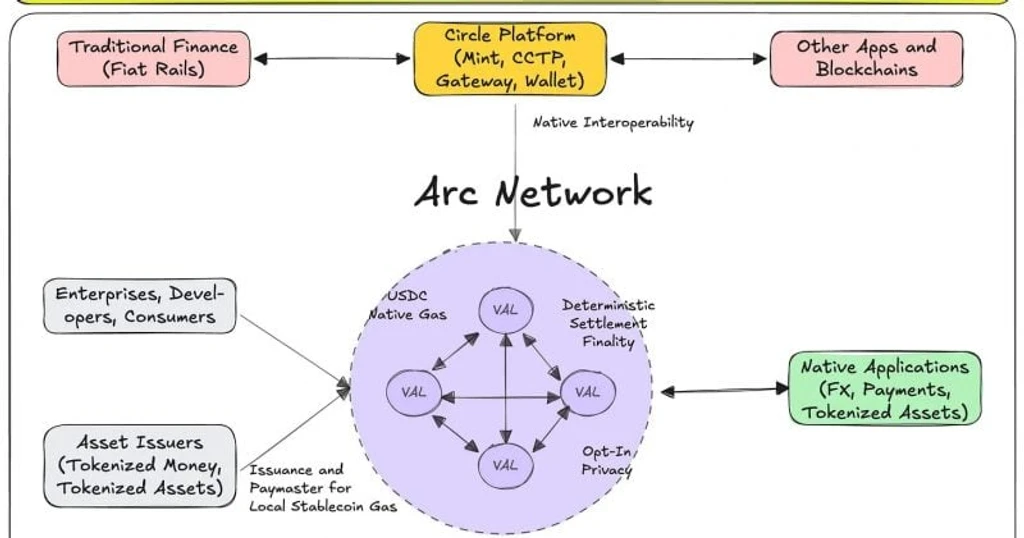
Circle CEO Jeremy Allaire has a theory about the future of money: most of it won’t be moved by humans. It’ll be moved by AI agents, autonomously, in amounts so small they’d make a credit card processor weep. That is the premise behind Arc.
Arc is Circle’s purpose-built Layer-1 blockchain, billed as the “Economic OS for the internet.” The company raised $222 million in a private presale of its native ARC token, achieving a fully diluted valuation of $3 billion. Backers include BlackRock, a16z crypto, Apollo, Standard Chartered, and ARK Invest.
The blockchain promises sub-second settlements and privacy controls optimized for AI-driven economic activities. Alongside the token presale, Circle launched the Circle Agent Stack-tools giving AI agents the ability to manage USDC, discover services, and automate transactions across multiple blockchains.
Allaire says Arc provides the operating system for an emerging economy powered by AI, enabling programmable dollars and nanopayments: transactions so tiny that processing them on Visa or Mastercard would cost more in fees than the transaction itself.
Circle introduced a public testnet in October 2025, with the full launch on May 11, 2026. Roughly 740 million ARC tokens were sold during the presale, implying a token price of roughly $4.05.
The presence of BlackRock and Standard Chartered in a token presale signals that AI-native financial infrastructure is not a niche experiment. The risk: the agentic economy remains more theoretical than practical. Investors betting on Arc are betting that machine-to-machine commerce becomes a significant category before competitors build equivalent rails on existing blockchains.