
Visa is testing whether privacy-enabled blockchain networks can support institutional stablecoin settlement without exposing sensitive transaction data. The proof of concept involves the stablecoin infrastructure company Brale and the Canton Network, a permissioned ledger backed by major Wall Street firms.
Announced Thursday, the project uses SBC, a US dollar-backed stablecoin issued by Brale, to simulate institutional payment flows on Canton. Visa is evaluating whether SBC could become another stablecoin option in its settlement program.
This initiative extends Visa’s earlier experiments using stablecoins for settlement on public blockchains, which began in 2021 with USDC settlement on Ethereum. It now targets banks and market infrastructure providers seeking onchain efficiency without broadcasting counterparties, positions, or flows on a public ledger.
The push comes as policymakers and analysts anticipate a broader shift in how payment stablecoins are used. S&P Global Ratings reported Thursday that global stablecoin issuance has surpassed $300 billion across currencies, though most demand remains tied to crypto trading.
US payment stablecoins that comply with the GENIUS Act are poised to expand into merchant remittances and certain commercial payments once rules are finalized. Cross-border payments are among the most promising near-term use cases, though they currently represent a minimal share of global international payment volumes.
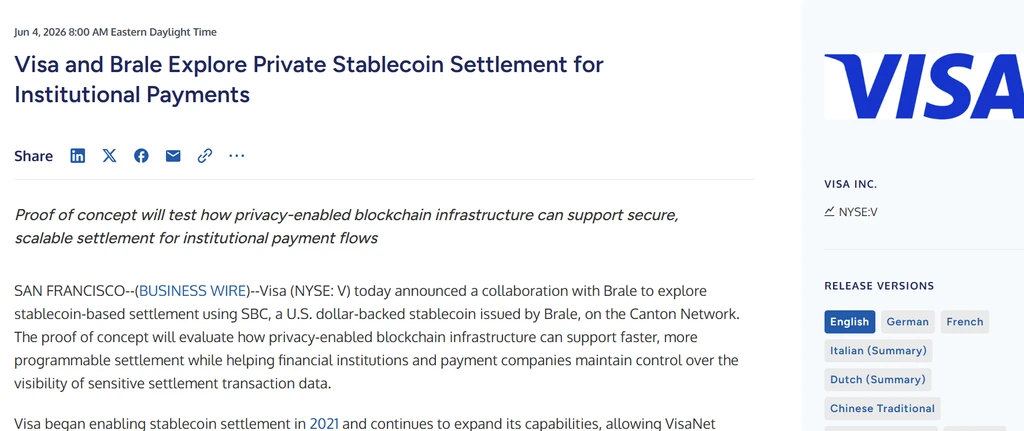
Visa and Brale explore private stablecoin settlement. Source: Businesswire
Canton, developed by Digital Asset, connects permissioned blockchain applications operated by institutions including JPMorgan, Goldman Sachs, BNP Paribas, and the Depository Trust & Clearing Corporation.
Unlike public chains, Canton is designed so that only transaction participants and authorized regulators can see specific deal data, while still allowing atomic settlement across tokenized assets, cash-like instruments, and other financial contracts.
The proof of concept will assess how Canton’s privacy architecture can support faster, more programmable settlement while allowing financial institutions and payment companies to retain strict control over the visibility of sensitive transaction and settlement data.
For banks, the stakes go beyond technology experimentation. S&P Global said stablecoins could threaten banks’ payments income and shift funding from insured retail deposits toward more concentrated wholesale balances. Banks that issue stablecoins or tokenized deposits may also capture new fee and funding opportunities, driving large financial institutions to test privacy-preserving settlement networks.