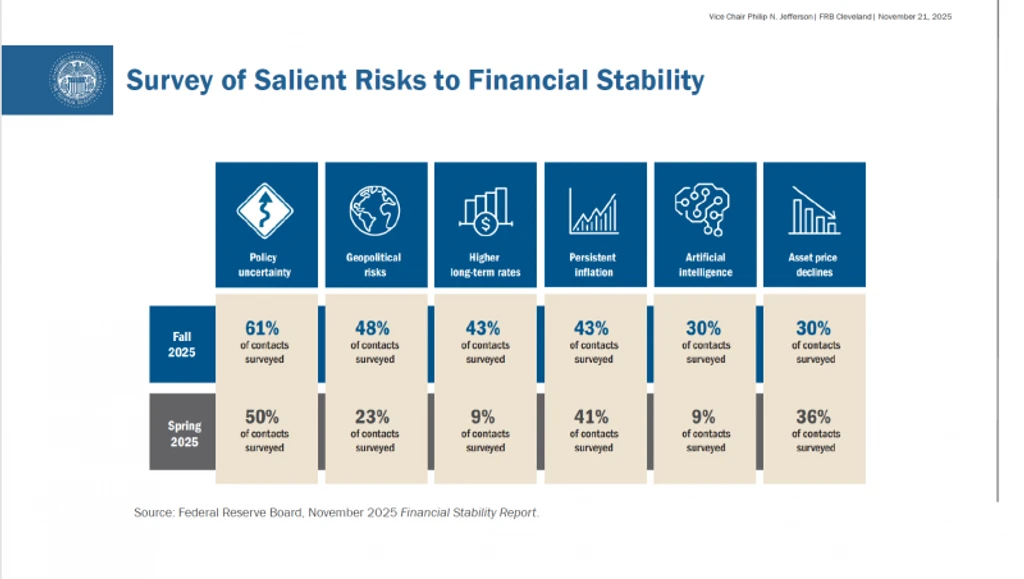
The Federal Reserve's Spring 2026 Financial Stability Report shows a major shift in risk hierarchy. Geopolitical risks now top the list, climbing from second place in Fall 2025 to become the most cited threat to US financial stability.
The escalation follows a US-Israel operation on February 28, 2026, that resulted in the killing of Iran's Supreme Leader. The incident triggered ongoing hostilities across the Middle East, escalating a simmering concern into a full-blown regional crisis threatening energy infrastructure and supply chains.
Also moving up the list is artificial intelligence. The Fed's survey positioned AI alongside geopolitical risk and inflation as a defining challenge for financial stability. The CFA Institute has classified AI-driven threats as persistent vulnerabilities, with particular emphasis on increasing cyber risks. BlackRock has echoed these concerns, emphasizing the growing dangers of AI in cybersecurity and economic inequality.
Nobel laureate Simon Johnson has warned about the threat to 'jobs with dignity,' arguing that AI fundamentally reshapes which kinds of labor have economic value. The Fed's own Beige Book confirmed AI-driven efficiency improvements across multiple sectors, while noting implications for employment.
Former FDIC Chair Sheila Bair has advocated for tax reforms to counteract AI-driven imbalances in capital allocation, arguing that current tax structures favor capital investment in automation over human labor.
The survey also flagged private credit redemptions and bank lending growth as areas worth watching. Private credit has ballooned to $1.7 trillion in assets under management, though redemption risks remain manageable at current levels.
Inflation was included among notable risks, creating a tension between lending growth and the inflation pressures that threaten stability.