
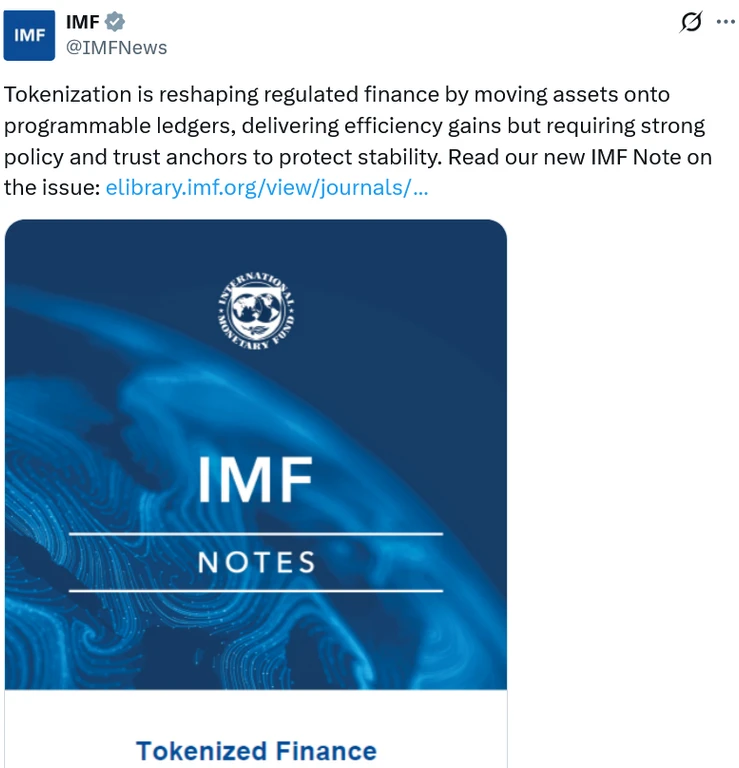
The International Monetary Fund (IMF) said tokenization can enhance financial efficiency by reducing friction and increasing transparency-but also poses risks to financial stability.
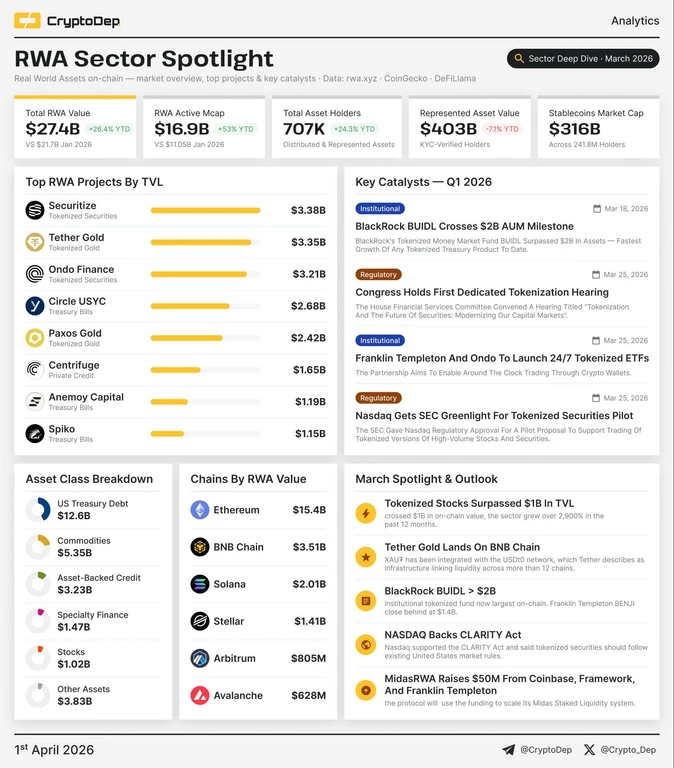
Tokenization of real-world assets (RWAs) now exceeds $27.6 billion, excluding stablecoins. Analysts project the market could reach $16 trillion by 2030.
The IMF noted that while tokenization improves issuance, trading, and settlement of securities, it also shifts risks to smart contracts and decentralized ledgers.
"Stress events in tokenized markets are likely to unfold faster than in traditional systems," the IMF warned, leaving less room for intervention.
Emerging markets may benefit from faster cross-border payments and financial inclusion, but face volatility from capital flows and currency substitution.
Wall Street firms like BlackRock are leading the charge, with Securitize managing $3.38 billion in tokenized assets. Other platforms such as Tether Gold and Ondo Finance follow closely.
Intercontinental Exchange plans a blockchain-based trading platform for 24/7 stock and ETF settlements.
Legal uncertainty remains a challenge, though standards like ERC-3643 aim to bring clarity through permissioned access.
Coinbase Asset Management recently launched tokenized Bitcoin yield fund on Ethereum layer 2 Base with compliance measures in place.