Nvidia has once again surpassed Wall Street's financial projections, announcing its latest quarterly results. The company's crucial data center business saw revenue climb more than 75% year-over-year, a significant driver of its stock's post-announcement gains.
Nvidia posted strong fourth-quarter performance across its segments. Earnings per share, excluding certain costs, reached $1.62, exceeding the analyst target of $1.53. Total revenue soared 73% to $68.13 billion, topping the consensus estimate of $66.21 billion.
The data center segment alone generated $62.3 billion in revenue, surpassing the Street's $60.69 billion expectation. This segment, vital for artificial intelligence workloads, now accounts for over 91% of Nvidia's total sales. The company's net income nearly doubled to $43 billion, a substantial increase from $22.1 billion in the prior year.
Looking ahead, Nvidia offered robust guidance, projecting first-quarter fiscal 2027 revenue of approximately $78 billion, with a 2% margin for error. This projection significantly outpaces Wall Street's $72.6 billion sales forecast. Notably, Nvidia's forecast already factors in potential revenue impacts from China.
Nvidia, under CEO Jensen Huang, has outperformed its megacap peers this year, largely due to the continued expansion of AI. Year-to-date, its shares have risen 5%, while the Nasdaq has seen a slight decline. Among trillion-dollar market cap companies, only Apple has shown modest gains.
Analysts widely anticipated Nvidia's strong performance, given consistent demand since the AI boom began in late 2022. Recent financial reports from major tech players like Alphabet, Amazon, Microsoft, and Meta indicate escalating demand for Nvidia's chips, with these companies collectively planning nearly $700 billion in AI data center investments this year, a significant portion allocated to Nvidia's GPUs.
Hyperscalers remain Nvidia's largest customer category, contributing over half of its data center revenue. However, concerns exist about the long-term sustainability of this dominance, as competitors like AMD and custom silicon development by cloud giants introduce new competitive dynamics. The focus is now on Nvidia's strategy to maintain its AI leadership as the buildout matures and enterprise return on investment questions arise.
Beyond its core chip business, Nvidia's networking segment within data centers also saw remarkable growth, with sales reaching $10.98 billion, up 263% year-over-year. This surge is attributed to the adoption of its NVLink technology and Spectrum-X Ethernet switches, crucial for connecting GPUs for large language models.
While gaming revenue saw a 47% increase, reaching $3.7 billion, analysts warn of potential headwinds later in the year. Memory chip shortages are likely to prioritize AI industry needs, potentially impacting console sales and Nvidia's new gaming GPU launches.
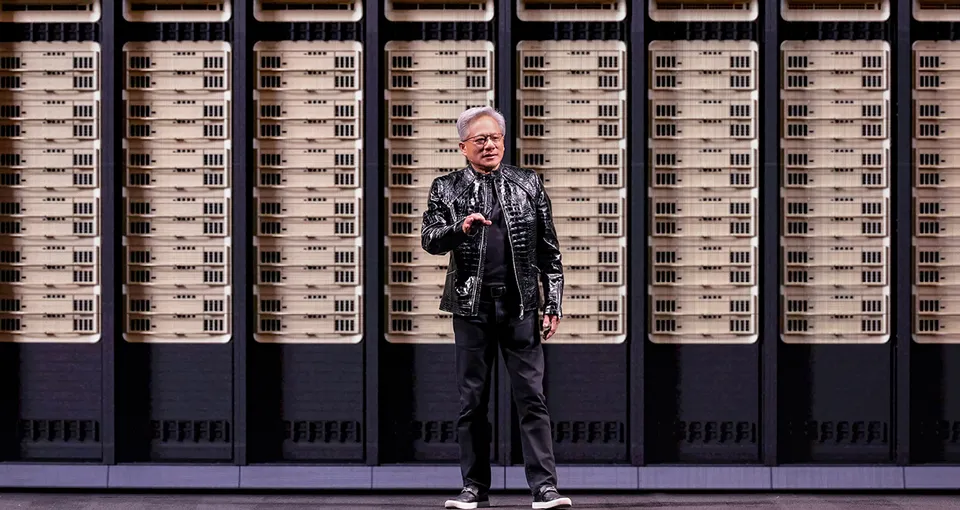
Nvidia is also advancing its next-generation Vera Rubin rack-scale GPU systems, designed to deliver significantly improved performance-per-watt. The company is currently shipping initial samples to customers, with production shipments slated for the latter half of the year.
Smaller business segments also showed mixed results. The automotive segment generated $604 million in sales, below expectations, while professional virtualization revenue exceeded targets at $1.23 billion.
CEO Jensen Huang highlighted Nvidia's substantial investments in AI labs and industry players, totaling over $17.5 billion in the past year, primarily supporting early-stage startups. Discussions are ongoing with OpenAI regarding a potential partnership agreement, with both parties expressing optimism about reaching a deal.