
Intercontinental Exchange (ICE), the parent company of the New York Stock Exchange (NYSE), is developing a blockchain-based platform not for cryptocurrency adoption, but to fundamentally upgrade market infrastructure. The initiative focuses on using distributed ledger technology to optimize collateral management and streamline legacy settlement systems.
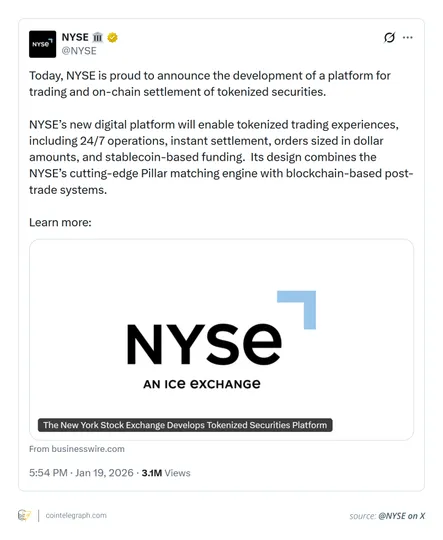
The platform aims to enable 24/7 trading and incorporate onchain delivery-vs.-payment (DvP) settlement. This onchain settlement is critical, as it significantly reduces counterparty risk and frees up capital by enabling near-simultaneous transfer of ownership and payment. Unlike traditional systems with multiple intermediaries, DvP minimizes operational complexity and reconciliation errors.
While 24/7 trading could expand global access, it may also lead to liquidity fragmentation and wider spreads during low-volume periods. The NYSE's approach separates trading execution, still managed by its existing Pillar matching engine, from post-trade settlement processes enhanced by blockchain.
Stablecoins are proposed as institutional settlement rails for 24/7 funding, requiring bank-grade custody, liquidity, and compliance safeguards. This positions them as wholesale settlement tools, not speculative assets.
This effort is part of a broader trend of tokenizing conventional assets like stocks and ETFs to improve operational efficiency, accelerate settlement, and reduce manual reconciliation. However, significant hurdles remain, including legal ambiguity around ownership, defining the authoritative source of truth for tokenized assets, and robust custody solutions for private keys.
Clearinghouses are also exploring blockchain integration for real-time risk management. This shift demands continuous monitoring, automated margin calls, and resilience against outages. While global investors and institutions could benefit from improved collateral mobility and access, intermediaries reliant on current multi-step settlement workflows may face pressure to adapt.
Ultimately, the NYSE's exploration of onchain systems represents a modernization of core financial infrastructure, leveraging blockchain as a technology layer for post-trade operations. Its success hinges on achieving regulatory approval, demonstrating scalability and operational resilience, and gaining institutional buy-in, setting a high bar for traditional exchanges integrating tokenization.