US mortgage lender Rate has launched a nationwide program enabling qualified borrowers to utilize verified cryptocurrency holdings for underwriting requirements, bypassing the need to liquidate assets. The initiative, named RateFi, allows borrowers to count crypto assets as qualifying reserves and, in some instances, as an income source within the lender's non-qualified mortgage framework.
RateFi employs a proprietary valuation framework that assesses digital assets based on market price, liquidity, and volatility to determine their qualification value, while still adhering to traditional mortgage risk standards. However, digital assets designated for down payments or closing costs must be converted to cash.
This program addresses the growing trend of cryptocurrency ownership, with over 10% of Americans holding digital assets, yet most traditional mortgage programs do not recognize crypto as qualifying collateral unless liquidated. Liquidating assets can trigger taxable events, making this offering appealing.
RateFi is designed to support established, high-liquidity cryptocurrencies and major US dollar-backed stablecoins, requiring proof of ownership and asset seasoning through monthly statements from approved custodians or exchanges.
Kate Amor, EVP at Rate, highlighted housing affordability pressures and younger generations' active participation in the digital asset economy as key drivers. She stated, "Younger generations are entering their peak homebuying years at a time when traditional paths to ownership are increasingly out of reach, yet they’re also the most active participants in the digital asset economy."
The program incorporates standard anti-money laundering (AML) and know-your-customer (KYC) verification, accessible via Rate's existing digital mortgage platform.
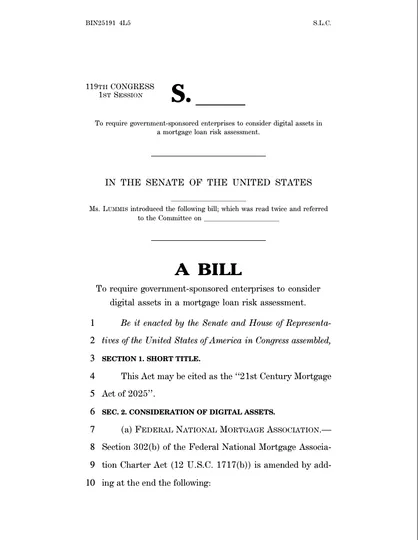
This development occurs amidst ongoing discussions about incorporating digital assets into housing finance frameworks. Federal Housing Finance Agency Director William J. Pulte has instructed Fannie Mae and Freddie Mac to explore treating cryptocurrency as a reserve asset in mortgage risk assessments. Senator Cynthia Lummis has also introduced legislation aimed at revolutionizing mortgage lending and increasing homeownership accessibility.