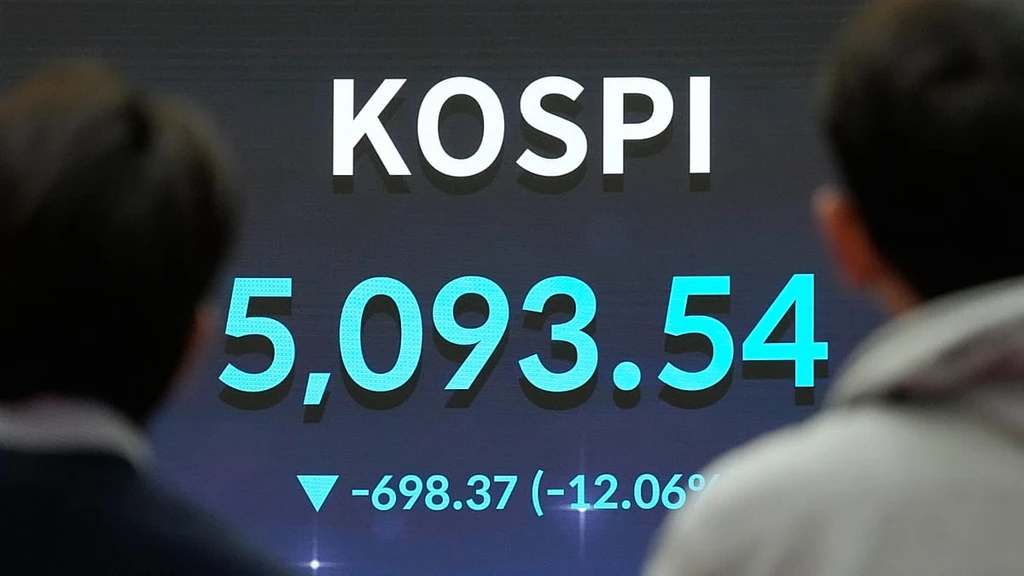
Seoul's Kospi index experienced its worst day on record, plummeting 12.1% to 5,093.54 and triggering a trading halt. The tech-heavy Kosdaq saw an even steeper drop of 14%. Major players like Samsung Electronics fell 11.7%, and SK Hynix lost 9.6%. Investor optimism surrounding AI semiconductor demand was overshadowed by escalating concerns over energy security.
South Korea, heavily reliant on Middle Eastern oil imports, is now acutely exposed to disruptions in maritime trade stemming from the Iran conflict. The Strait of Hormuz, a critical chokepoint for global oil flow, has become a major flashpoint. Approximately 20 million barrels of oil pass through daily, with Asian economies like South Korea, Japan, China, and India accounting for roughly 75% of these flows.
Oil prices saw continued gains, though moderated after President Trump announced measures to safeguard shipping lanes. US benchmark crude traded at $77 per barrel, and Brent crude exceeded $84, marking their highest levels since 2024. Both contracts have surged approximately 15% this week, contributing to market volatility.
President Trump stated he ordered the US Development Finance Corporation to provide political risk insurance for maritime trade and indicated the US Navy would escort tankers through the Strait of Hormuz if necessary. Analysts, however, caution that these measures may only partially mitigate risks, with higher insurance costs and a persistent "war premium" likely to remain.
Across Asia, markets also slumped. Tokyo's Nikkei 225 dropped 3.9%, and Hong Kong's Hang Seng fell 2%. Shanghai's Composite lost around 1%, and Taiwan's Taiex shed 4.4%. This broad sell-off reflects anxieties about prolonged Middle East instability impacting corporate profits and slowing the global economy, particularly for trade-dependent Asian nations.