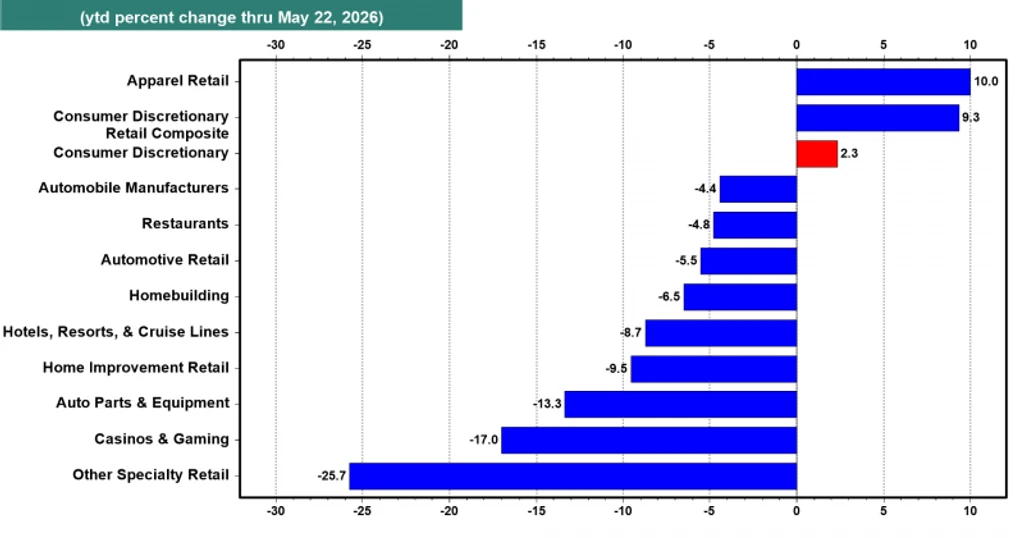
The S&P 500 is having a great year. Consumer discretionary stocks are not invited to the party.
The ratio between the S&P 500 Consumer Discretionary sector and the broader index has sunk to its lowest level in 20 years. While the S&P 500 recently crossed 6,600 for the first time, traditional consumer-facing stocks have been left behind.
Persistent inflation, elevated interest rates, and tariff policy adjustments are weighing on the sector. The Consumer Discretionary Select Sector SPDR ETF (XLY) posted a roughly 10% trailing one-year return, compared to the S&P 500's 36% surge from its April 2025 low.
The index's march has been propelled by advances in artificial intelligence and tech mega-caps. This divergence raises a structural question about what the S&P 500 actually measures. If the index can hit all-time highs while the consumer sector sits at a two-decade relative low, it indicates more about AI sentiment than the real economy.
For investors, the 20-year relative low attracts two types: contrarians seeing value and momentum followers avoiding the sector. Key indicators to watch are inflation, interest rate decisions, and consumer confidence. Consumer spending accounts for a massive share of GDP, and this divergence could be a warning sign for the broader economy.