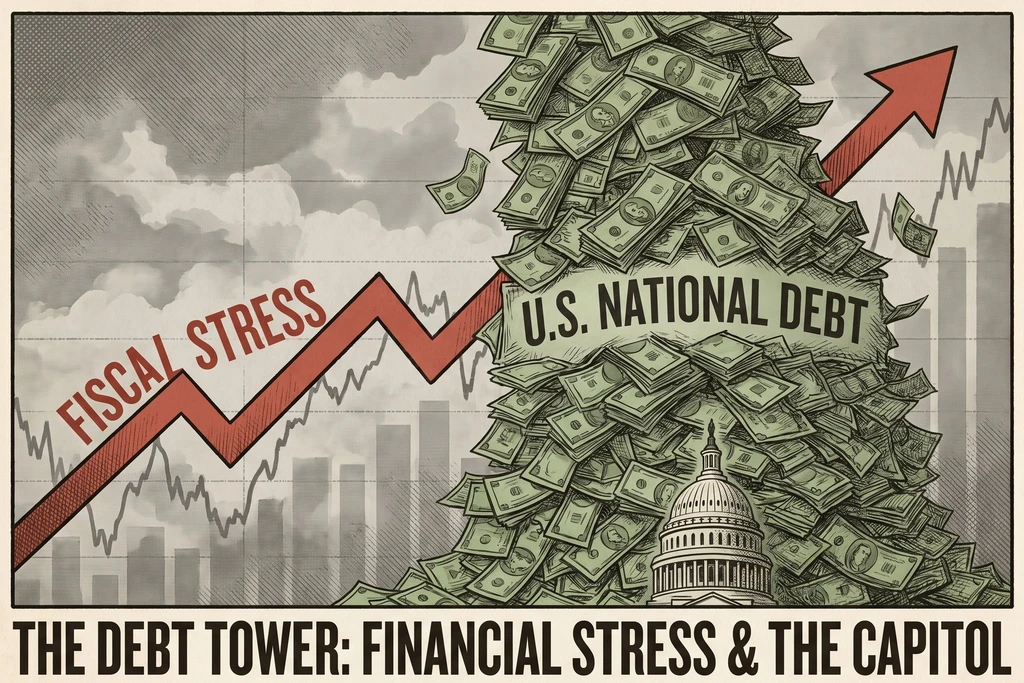
The United States' national debt has officially surpassed 100% of its Gross Domestic Product (GDP), a milestone that carries heavy financial consequences. Last year, the federal government spent $1 trillion on interest payments alone-more than the entire defense budget and nearly double the spending on children.
Marc Goldwein, senior policy director at the Committee for a Responsible Federal Budget, warns this trajectory is unsustainable. "The high inflation of 2021 and 2022 was partially driven by very high deficits," he said. "The 6.5% to 7% mortgage rate you might be getting on your new home is driven in part by the high debt we have."
While crossing the 100% threshold is symbolic, economists fear a "debt spiral"-where high debt pushes up interest costs, which in turn increase debt further. This cycle can lead to higher inflation, elevated interest rates, and suppressed wage growth.
The Social Security Trust Fund is projected to run out of money in about six and a half years, which could trigger automatic benefit cuts of roughly 25% for retirees. "A typical couple retiring in 2032 would see their benefits cut by $18,000," Goldwein noted.
To stabilize the situation, Goldwein advocates for a target where the debt does not grow faster than the economy-specifically, capping annual borrowing at 3% of GDP, a level the U.S. last achieved in 2015. This would require bipartisan action on spending and revenue, a tall order in the current polarized political climate.