Asian teams have rarely made deep runs at the World Cup, but the continent has produced some of the tournament's most memorable underdog stories.
North Korea 1966: Asia's first win
North Korea's World Cup qualification turned out to be a headache for the host, England. At the time, Britain did not recognise the communist government of North Korea. British officials feared that allowing North Korea's attendance at the tournament would cause problems, particularly with South Korea.
On the field, North Korea faced a mountain to climb. Grouped alongside heavyweights the Soviet Union, former world champions Italy and the third-placed team from the previous World Cup Chile, North Korea were not expected to get anywhere near the knockout stages.
Their opening match was a disastrous 3-0 defeat by the Soviet Union. Against Chile, an equaliser two minutes from time earned them a 1-1 draw - and a lifeline. They then did the impossible by beating two-time world champions Italy in the last group game.
In the 42nd minute, a header found striker Pak Doo-ik at the edge of the box, and he smashed the ball past the Italian goalkeeper. The North Koreans then held on for their first World Cup victory, and Asia's first as well.
Their second-place finish in Group 4 set up a clash with Portugal. What followed was one of the World Cup's great matches. North Korea shocked the Goodison Park crowd by racing to a 3-0 lead inside 25 minutes, only for legendary striker Eusebio to score four times as Portugal fought back to win 5-3.
Saudi Arabia 1994: Green Falcons land on the big stage
After North Korea's heroics in 1966, Asia's next win at a World Cup would again come from a team making its debut - Saudi Arabia.
The Green Falcons were drawn into a group with the Netherlands, Morocco and Belgium. The team lost 2-1 in their opening fixture to a Dutch team that included Frank Rijkaard, Dennis Bergkamp and Ronald Koeman, before bouncing back in their next match to beat Morocco 2-1 for their first World Cup victory. In their final group game, they defeated Belgium 1-0 to qualify for the knockout stages.
That Belgium game is best remembered for Saeed Al Owairan's mazy solo goal, reminiscent of Diego Maradona's effort against England in 1986.
There was to be no upset against Sweden, however, as the Scandinavians claimed a 3-1 victory on their way to a third-place finish.
South Korea 2002: Asian co-host makes it to the semis
South Korea and Japan were co-hosting the first World Cup on Asian soil. The Taeguk Warriors were led by Dutch coach Guus Hiddink, who had guided the Netherlands to a fourth-place finish four years earlier.
They had played in five World Cups without winning a match. But in front of a home crowd, they ended that run in emphatic fashion. First, they beat Poland 2-0, before drawing 1-1 with the US. They then dumped a Portugal side including Rui Costa and Luis Figo out of the tournament by winning 1-0 to top their group.
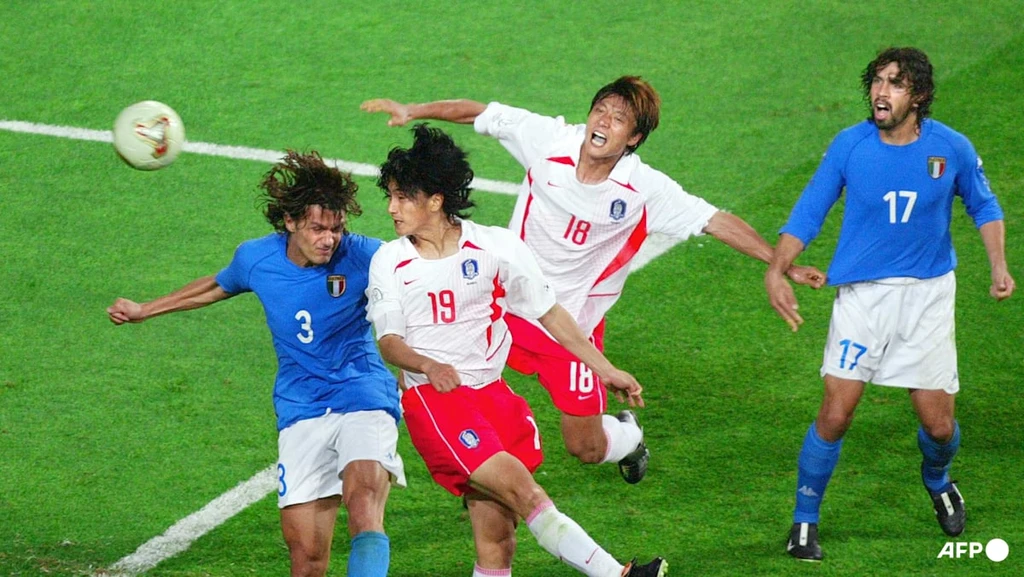
In the round of 16, they faced an Italian team boasting generational talent such as Gianluigi Buffon, Paolo Maldini, Francesco Totti and Alessandro Del Piero.
In a physical affair, Italy took the lead, only for South Korea to equalise two minutes from time. Then came Ahn Jung-Hwan's golden-goal header, sparking euphoria across South Korea. Against Spain, the match ended goalless and had to be decided by penalties. After goalkeeper Lee Woon-jae saved Joaquin's spot-kick, captain Hong slotted his penalty past Iker Casillas to send South Korea into the semi-finals.
However, South Korea fell 1-0 to Germany in the last four and went on to lose to Turkiye in the third-place play-off.
Japan 2022: Samurai Blue slay giants to top group
Heading into Qatar 2022, Japan had the experience of progressing to the round of 16 on three occasions. But few fancied their chances of making it out of the group stage this time around, with heavyweights Germany and Spain favourites to go through instead.
Yet the Samurai Blue pulled off the impossible - not only did they qualify from their group, they topped it. Japan came from behind in both their 2-1 wins against Germany and Spain. The results were a testament to their resilience, especially after a 1-0 defeat to Costa Rica on matchday two threatened to derail their campaign.
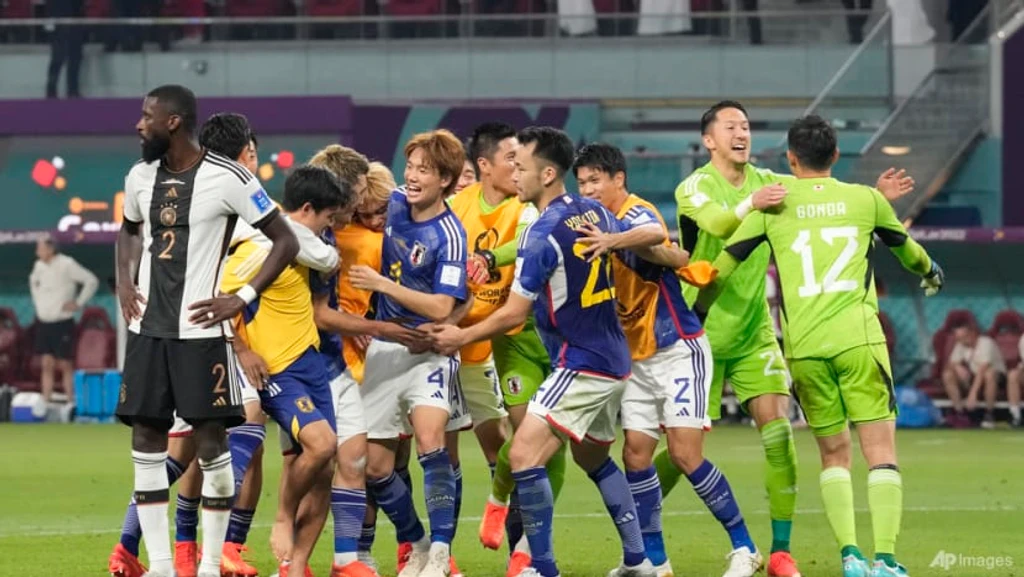
In the win against Spain, Japan had only 18 per cent ball possession - the lowest recorded for a winning team in a World Cup game, according to FIFA.
Japan coach Hajime Moriyasu had said before the tournament that the target for Japan was to get beyond the round of 16 for the first time. However, that was not to be, as they lost to 2018 finalists Croatia in the next round. After a 1-1 draw over 120 minutes, Japan bowed out on penalties to the eventual third-placed team.
Reflecting on the campaign, Moriyasu said: "The players showed us the future, a new era of Japanese football. We beat Germany, we beat Spain ... If we take confidence in that, and if we think about overtaking these teams rather than just catching up, the future is bright."