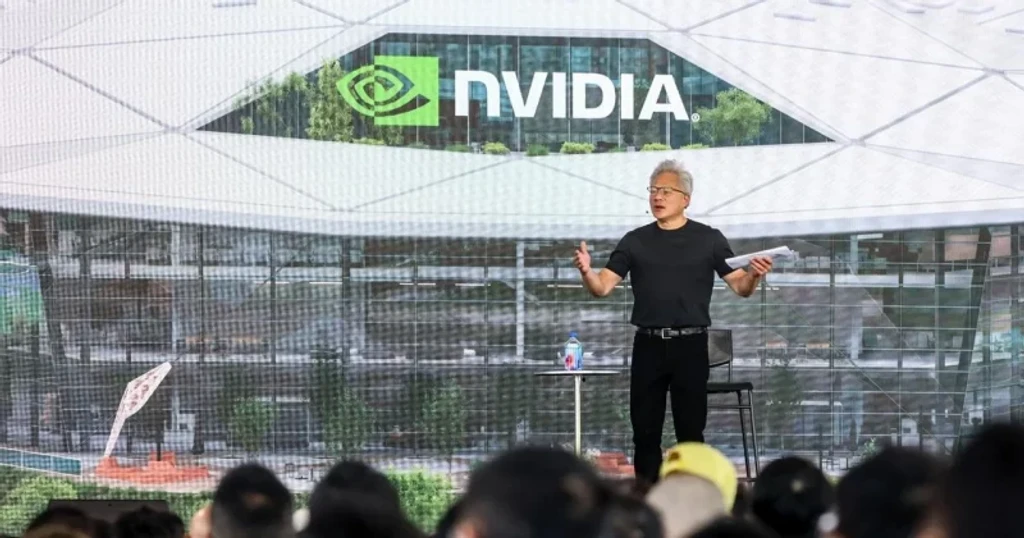
Nvidia is pledging $150 billion a year to Taiwan, a sum roughly equal to Hungary’s entire GDP, to build the physical backbone of artificial intelligence.
CEO Jensen Huang announced the figure in Taipei, calling Taiwan the “epicentre of the AI revolution.” That $150 billion marks a steep climb from about $100 billion currently spent in the island’s semiconductor ecosystem. Just five years ago, Nvidia was investing only $10 billion to $15 billion annually.
Nvidia plans to open a new headquarters in Taiwan by 2030, expected to create roughly 4,000 jobs. The core of the investment, however, is about chips. Nvidia designs the brains of AI systems but relies on Taiwan Semiconductor Manufacturing Company (TSMC) to fabricate them.
Nvidia’s market cap now sits at roughly $5 trillion, a valuation built on surging AI demand. The trajectory-from $10 billion to $150 billion in five years-signals a belief that AI demand is accelerating, not plateauing.
For investors, TSMC is a direct beneficiary, locked into a growing revenue stream with Nvidia. But concentrating $150 billion annually in Taiwan concentrates geopolitical risk. The Taiwan Strait remains a global flashpoint. Any disruption to semiconductor production would ripple across tech.
The risk to watch: execution. Sustained demand must justify this outlay. A slowdown in AI adoption could turn ambition into overcapacity.