A large-scale pro-Kremlin disinformation campaign is targeting Armenia ahead of its parliamentary elections on 7 June, researchers say.
In total, 343 fake videos were published by early May, prompting analysts to describe the operation as one of the most extensive in recent years - second only to the campaign observed during Moldova's 2025 election.
According to researchers, the campaign began in early March and was part of 'Matryoshka' - a pro-Kremlin disinformation operation that has increasingly used artificial intelligence.
Among the fabricated videos, a central narrative claims that a victory for Prime Minister Nikol Pashinyan, whose campaign focuses on a pro-European direction, could trigger a war between Armenia and Russia.
Researchers say bots are also spreading false claims on social media platforms such as X in an apparent effort to undermine Pashinyan.
No evidence supports these allegations.
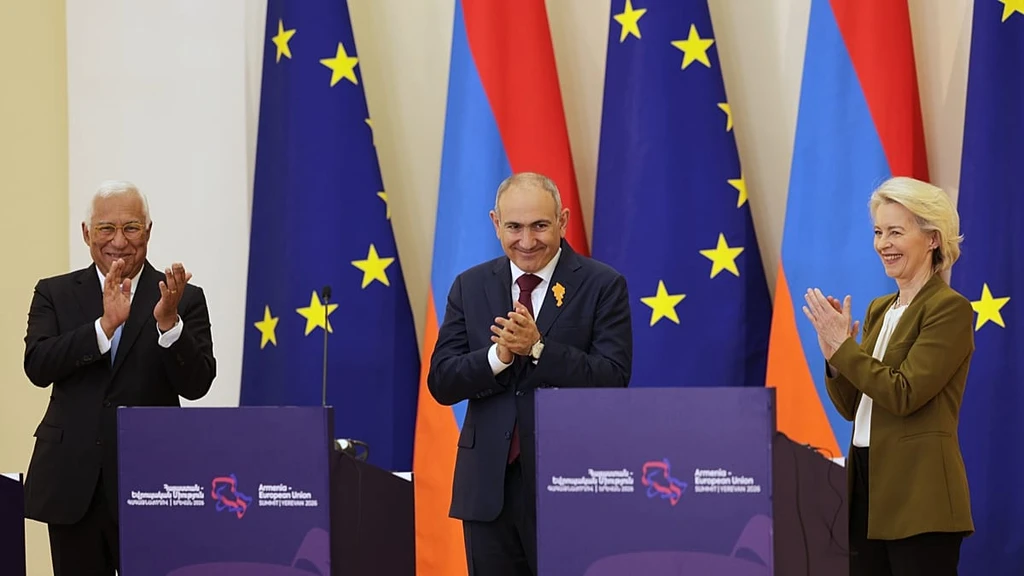
The election campaign has unfolded against a backdrop of growing cooperation between the EU and Armenia, highlighted by the first EU-Armenia summit held in the country in early May.
Several senior European figures attended, including European Commission President Ursula von der Leyen, European Council President António Costa, and France's President Macron.
Two months after the campaign began, Russian President Vladimir Putin drew a comparison between Armenia and Ukraine during a press conference on Victory Day, warning that Armenia could face similar consequences if it pursued closer integration with the EU.
On 26 March 2025, the Armenian parliament voted by a large majority to launch a process towards EU accession, in a move backed by Pashinyan's Civil Contract party.
Alongside the Matryoshka campaign, another pro-Kremlin disinformation campaign, known as Storm-1516, is also spreading false narratives targeting Pashinyan on social media, according to researchers from Clemson University's Media Forensics.
'Russian campaigns are targeting Armenia for the same reasons they interfered in elections in Moldova and Hungary,' said Ella Murray, a digital influence analyst at Clemson. 'They want to discredit pro-Western candidates and reassert regional influence.'