
Bitcoin's recent tendency to move in step with U.S. equities does not erase its value as a portfolio diversifier, according to financial services firm NYDIG.
Greg Cipolaro, NYDIG's global head of research, stated that while correlations with indices like the S&P 500 and Nasdaq 100 have risen, equities explain only a small fraction of Bitcoin's price movements. Statistically, this means only about a quarter of price changes are driven by stock market factors, with the remaining three-quarters tied to forces unique to the crypto market.
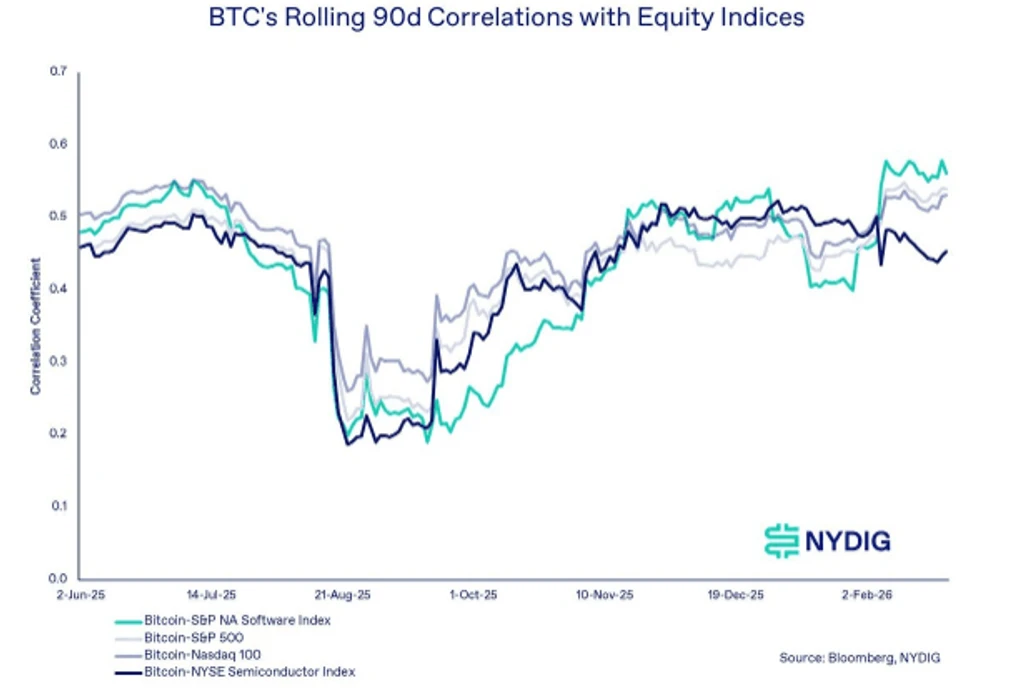
These unique forces include capital flows into Bitcoin funds, shifts in derivatives positioning, network adoption trends, and regulatory developments. Cipolaro suggests the current price alignment reflects the broader macroeconomic backdrop rather than a structural merger of asset classes, as both Bitcoin and growth stocks are sensitive to liquidity conditions and investor risk appetite.
The debate surrounding Bitcoin has evolved from its survival to its potential as a sovereign reserve asset. Prominent investors have raised questions about its suitability for central bank balance sheets, citing volatility and regulatory risks. However, Cipolaro argues that Bitcoin's long-term growth is not dependent on central bank adoption. Instead, its value is derived from its globally distributed network, political neutrality, and unique properties enabling censorship-resistant value transfer, digital scarcity, and independent operation free from any single authority.