
Bitcoin has suffered one of its sharpest declines of the year, with over $1.28 billion in long liquidations triggered in the first five days of June. Prices are now testing the critical $60,000 support level.
The sell-off began after stronger-than-expected US labor market data. The economy added 172,000 jobs in May, well above forecasts. This reinforced expectations that the Federal Reserve will maintain a restrictive monetary policy, with rate hike odds rising from 40% to 57%. The broader market felt the pain: roughly $2.5 trillion was erased across major assets, including the S&P 500, Nasdaq, gold, silver, and Bitcoin.
Beyond macro factors, excessive leverage remains a concern. Funding rates have stayed positive even as prices fell, indicating traders are still betting on a rebound. Bitcoin open interest remains elevated, though it has eased from its peak. Meanwhile, US spot Bitcoin ETFs saw approximately $1.40 billion in weekly net outflows, removing a key source of demand. Exchange inflows have also risen, traditionally a sign of increased selling pressure.
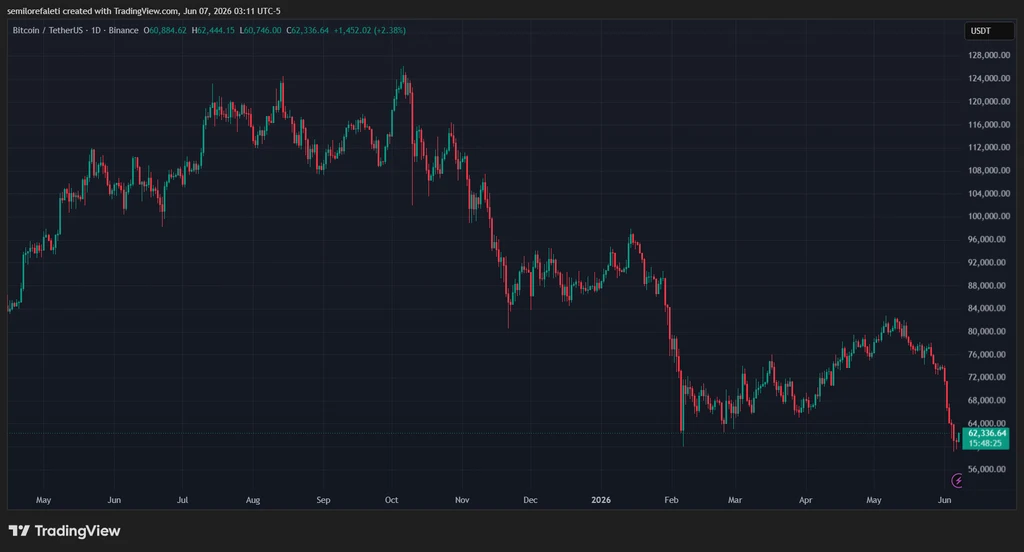
At press time, Bitcoin trades around $61,593. Analyst Axel Adler Jr. warns that $60,000 is the cycle low. For a sustainable recovery, ETF outflows, exchange inflows, and futures market leverage must all cool off to avoid a cascading liquidation event.