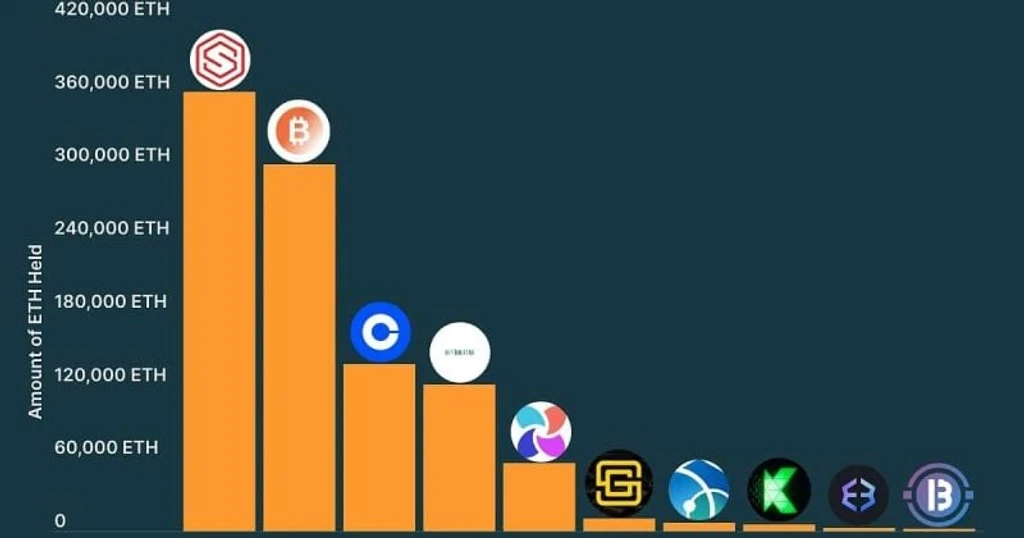
Public companies now hold roughly 7.3 million ETH on their balance sheets, a war chest valued at nearly $16 billion at current prices. It signals corporate treasurers are treating Ethereum less like a speculative bet and more like a productive asset.
While Bitcoin's corporate treasury narrative has dominated headlines, Ethereum has been quietly experiencing a sharper surge in institutional adoption. The key difference: ETH allows holders to earn yield.
Ethereum's proof-of-stake network lets holders lock up their ETH and earn staking rewards, a feature Bitcoin doesn't offer. Over 27 million ETH, worth approximately $50 billion, is currently staked. Beyond that, companies are exploring interest from decentralized finance products on Ethereum, which accounts for over two-thirds of all DeFi total value locked, with roughly $71 billion in deposits.
This combination of staking rewards and DeFi yields creates a compelling argument for holding ETH as a treasury asset: appreciating collateral that also generates income.
When 7.3 million ETH moves onto corporate balance sheets, it functionally exits the liquid market. Those tokens are being staked, deployed in DeFi protocols, or held as long-term strategic reserves. Ethereum's EIP-1559 fee-burning mechanism permanently destroys a portion of ETH with every transaction, creating structurally declining supply.
Analysts note corporate ETH accumulation is increasingly concentrated among a small number of entities. The 27 million ETH staked plus the 7.3 million held by corporations represents a substantial chunk of Ethereum's total supply not hitting the open market anytime soon.
Corporate adoption was enabled by spot ETH ETFs in major jurisdictions, giving institutional investors a regulated on-ramp. Ethereum's position as the dominant smart contract platform, holding over two-thirds of total DeFi TVL, provides the deepest liquidity and widest range of yield-generating opportunities.
The $16 billion figure represents the maturation of ETH as an asset class. These are multi-year strategic positions, creating a floor of demand that didn't exist two years ago. Risks remain: regulatory uncertainty around staking, potential DeFi tax treatment changes, and smart contract vulnerabilities.