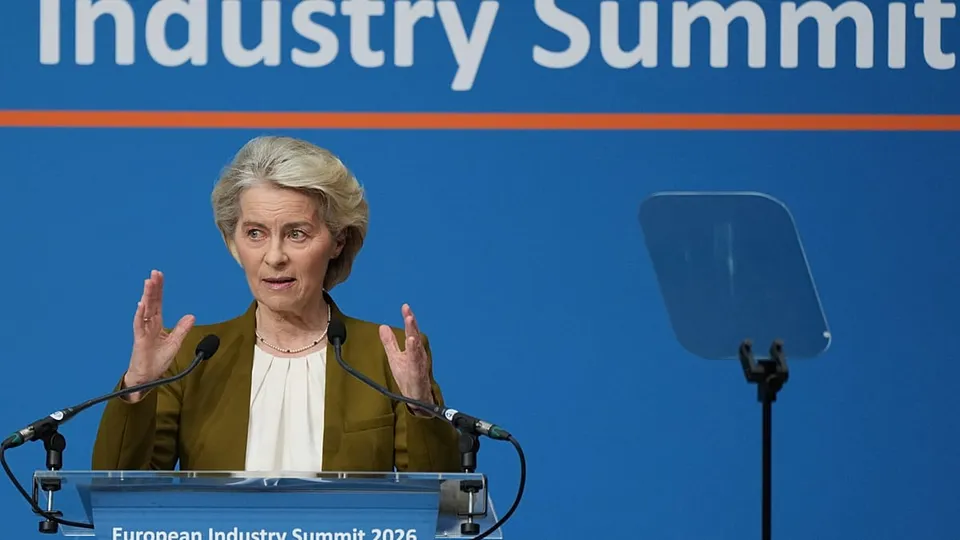
European Commission President Ursula von der Leyen has launched "One Europe, One Market," a strategy designed to transform the EU's fragmented single market into a unified economic powerhouse within two years. The initiative aims to bridge the significant competitiveness gap with the United States and China.
The EU is projected to account for only 12.91% of global GDP by 2030, trailing behind China (20.36%) and the U.S. (13.86%). Von der Leyen highlighted that "interstate barriers in our Union are three times higher than interstate barriers in the US," hindering economic growth.
The strategy focuses on five key pillars: regulatory simplification, a unified market, trade, digital infrastructure, and energy. The Commission plans a "deep house cleaning on the acquis," reducing directives in favor of regulations to ensure uniform application across member states.
Companies currently face a "market of 27," leading to increased business costs and reduced consumer welfare. Non-tariff barriers cost an estimated €150 billion annually in capital markets and hundreds of billions more in goods and services. High energy prices, two to three times greater than in the U.S. and China, make energy-intensive industries unsustainable.
The initiative includes "omnibus" legislative packages to cut administrative burdens, aiming for an annual cost reduction of approximately €15 billion for businesses. A new "EU Inc." framework will offer a single, optional, EU-wide corporate rulebook for companies operating across the bloc.
The strategy also prioritizes energy independence by modernizing and expanding the EU's energy grid, removing cross-border barriers, and exploring changes to the electricity pricing system to favor renewables. In the digital sector, the Digital Networks Act aims to boost telecom investment and consolidation, while a European Business Wallet will streamline interactions with authorities.
Trade policy is being reoriented from pure liberalization to strategic independence, focusing on de-risking and diversifying supply chains to reduce reliance on single suppliers. The goal is to strengthen the single market by simplifying internal rules and removing measures that fragment it.