Zoho, celebrating 30 years as a bootstrapped company, is positioning itself as a bulwark against the existential threat of autonomous AI agents to Software-as-a-Service (SaaS).
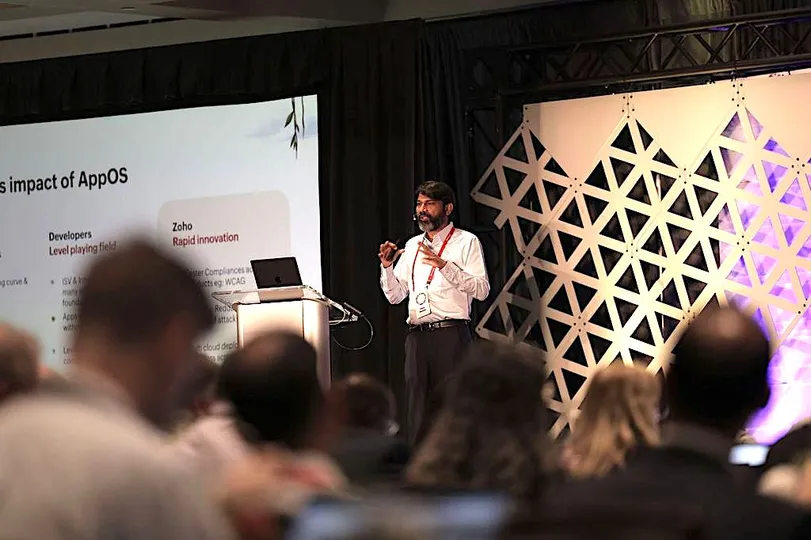
At its fifth analyst event, Zoho introduced AppOS, an extension of its "operating system for business" concept. This new approach aims to create a stronger reliability layer to unify over 50 business applications and thousands of integrations, addressing the complexity of modern enterprise IT environments where customers often manage over 200 applications.
Zoho's Chief Executive, Mani Vembu, highlighted the challenge of fragmentation caused by MCP servers and coding agents. AppOS provides a unified semantic integration, development, and data platform designed for human-agent collaboration on custom app development, prioritizing data sovereignty and privacy.
While some predict AI agents could lead to an "extinction-level event" for SaaS, Zoho views this as a culling of weaker solutions. The company emphasizes that only the strongest, business-value-adding applications will survive. Zoho's strategy involves integrating AI into existing systems of record and collaboration tools, recognizing that these are now strategic assets.
Zoho's AI integration approach is architecture-first. Core systems like CRM and ERP, along with low-code tools such as Zoho Creator and Zoho Flow, are positioned as essential resources for AI agents. This allows developers to focus on domain expertise and customer-facing features rather than extensive coding.
Mo Umerji, head of enterprise architecture at Newcross Healthcare Solutions, noted the importance of data privacy, stating that their data remains within a closed ecosystem with Zia AI and Zoho, preventing LLMs from training on sensitive information.
Zoho is also addressing the energy consumption of AI by developing specialized Small Language Models (SLMs). Ramprakash Ramamoorthy, director of AI research at Zoho Labs, explained that system constraints are built into AI logic to allow customers to rightsize models for cost and sustainability. The company is also expanding its data center capacity and developing AI data centers that can efficiently run inferences on commodity GPUs.
Zoho is experiencing significant growth through its channel partners, with a substantial portion of its revenue coming from regions like Asia, Africa, and Latin America. The company offers partners a Vertical Studio to build industry-specific solutions, from legal operations to automotive dealerships. Catherine Carignan-Turcotte, chief business development officer at NSI Solution, praised Zoho's ability to customize and scale applications within Vertical Studio for franchise needs.
Zoho's privacy-first stance is gaining international traction, particularly as companies and countries prioritize data sovereignty amidst security concerns. The integration of its ManageEngine subsidiary further enhances its ability to support larger enterprise customers, offering repackaged ITOM/ITSM solutions and white-labeling operations and security for MSPs.
While Zoho's advertising has expanded, its core strategy remains focused on bringing practical AI to developing economies and gaining traction with larger enterprises. The AppOS aims to provide context for apps and AI agents, enabling humans with domain expertise to deliver greater value. Jeff Anderson, vice president of IT at INTEGRIS Credit Union, described Zoho as a "force multiplier" for understanding customers in their digital environment.