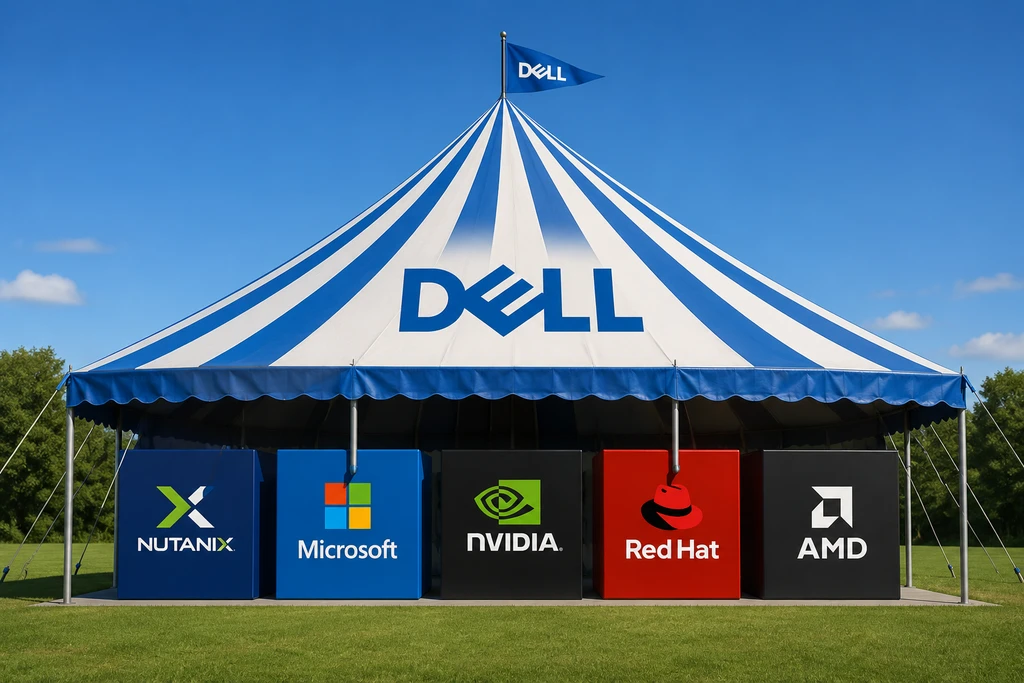
A major reorganization is underway in enterprise infrastructure, with Dell Technologies at the center. To succeed, Dell is expanding its "big tent" of strategic partnerships.
Dell’s alliance with Nutanix offers scalable hyperconverged infrastructure for virtualized workloads and private clouds. Travis Vigil, Dell’s SVP of product management, says customers need a flexible and resilient modern data center. Dell’s PowerEdge XC Plus and PowerFlex integration with Nutanix provide hypervisor choice and independent scaling of compute and storage.
Dell’s partnership with Nvidia powers the Dell AI Factory, combining Dell’s servers and storage with Nvidia’s latest AI chips. Over 4,000 customers already deploy these systems. The Dell Lightning File System, a high-performance parallel architecture, addresses AI’s massive data throughput demands without CPU bottlenecks.
AMD also plays a key role, with its EPYC processors integrated into Dell’s PowerEdge servers, enabling up to 192 cores per server. Dell recently announced support for AMD Instinct MI350P GPUs, targeting enterprises needing predictable AI performance at scale.
Microsoft collaboration integrates Dell PowerStore into Azure Local, allowing hybrid cloud adoption without new hardware. Dell PowerScale for Azure brings OneFS file storage natively into the Azure portal, unifying on-premises and cloud management.
With Red Hat, Dell offers the APEX Cloud Platform for OpenShift, combining Dell’s infrastructure with Red Hat’s container orchestration for simplified hybrid cloud management. Travis Zhao, Dell’s director of product management, notes a 25-year relationship, now deepened with a jointly engineered, easy-to-consume product.
John Furrier of theCUBE Research observes that no single vendor owns the full stack. The new model is loosely coupled technically but operationally unified at the customer experience layer. Ecosystem depth is the new defensibility.