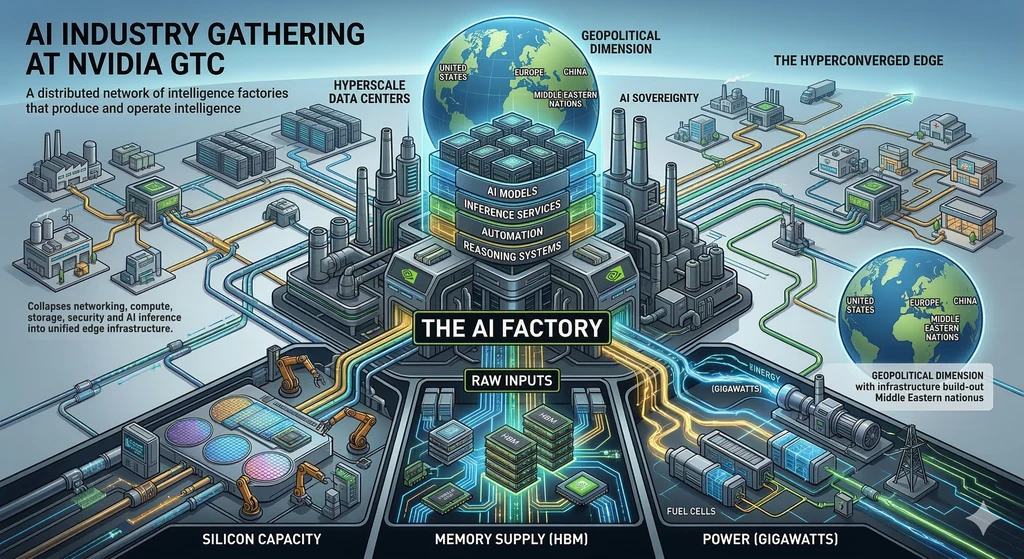
Every year, Nvidia's GTC conference draws attention to faster GPUs and bigger models. But the real transformation lies beneath the surface - the rise of the AI factory.
These are vertically integrated systems that convert power, silicon, memory, and data into AI models, inference services, and automation. Leading tech giants like Nvidia, Amazon, Microsoft, Google, and Meta are investing hundreds of billions in this industrial shift.
Unlike traditional hardware, AI GPUs like the H100 are appreciating in value as models grow more powerful. Compute has become the most constrained resource in the digital economy - turning GPUs into productive capital assets.
Memory, especially high-bandwidth HBM, is now the hidden bottleneck. By 2026, up to 30% of hyperscaler spending may go toward memory alone.
At the upstream limit is ASML, the Dutch firm producing extreme ultraviolet lithography machines - only 70-100 per year. This cap restricts how fast advanced chips can be made.
Power is another critical factor. Frontier AI clusters demand gigawatts, but companies are bypassing grid delays with on-site natural gas turbines, microgrids, and modular data centers.
Meanwhile, the AI factory is extending beyond central data centers to the hyperconverged edge - localized systems in factories, hospitals, and smart cities enabling real-time decisions with low latency and data sovereignty.
This distributed architecture divides roles: hyperscale facilities train models; edge systems run them.
Geopolitics also shapes the race. Nations view AI infrastructure as vital to national sovereignty. China is pursuing full-stack vertical integration via Huawei. Europe and the Middle East are building sovereign compute capacity.
The AI boom is no longer a software cycle. It’s an industrial revolution - one defined not by code, but by infrastructure control.
The winners in the next decade won’t just have better algorithms. They’ll have secured the supply chain: lithography tools, memory wafers, power plants, and edge deployment. The AI factory is becoming the backbone of the digital age.