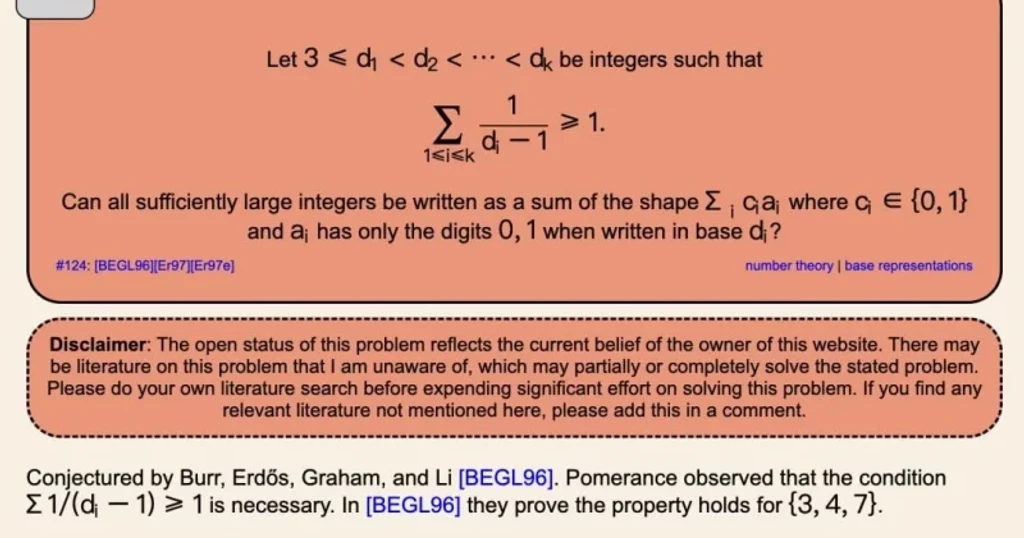
A machine just solved math problems that stumped humans for decades. Google DeepMind's AlphaProof Nexus has autonomously cracked 9 out of 353 open Erdős problems and proved 44 out of 492 open conjectures from the Online Encyclopedia of Integer Sequences (OEIS). The cost per problem: a few hundred dollars. The problems themselves had, in some cases, gone unsolved for longer than most people reading this have been alive.
AlphaProof Nexus addresses AI hallucination by pairing an AI model's generative capacity with formal proof-checking through the Lean proof assistant. The AI proposes a proof, and then a separate verification system checks every logical step. If the proof doesn't hold up, it gets rejected. The system uses what DeepMind calls "agentic loops" associated with proof-checking, iterating and refining proofs against the formal checker until they either pass or the system concludes it can't solve the problem.
Paul Erdős was one of the most prolific mathematicians in history. Solving 9 out of 353 open Erdős problems is roughly 2.5%. Each one represents a frontier of mathematical knowledge where professional mathematicians have made little or no progress, sometimes for decades. Proving 44 out of 492 open OEIS conjectures, roughly 9%, demonstrates that the system can operate across a range of mathematical domains.
AlphaProof Nexus builds on DeepMind's previous work with AlphaProof, which achieved silver-medal level performance at the 2024 International Mathematical Olympiad. The jump from Olympiad solver to research-level prover is significant.
AlphaProof Nexus has no direct connection to cryptocurrencies or tokens. DeepMind built this for mathematical research. However, the core technology-AI-driven formal verification-sits at the intersection of several problems the crypto industry cares about. Smart contract auditing, zero-knowledge proof generation, and cryptographic protocol verification all rely on ensuring that logical statements are provably correct.