
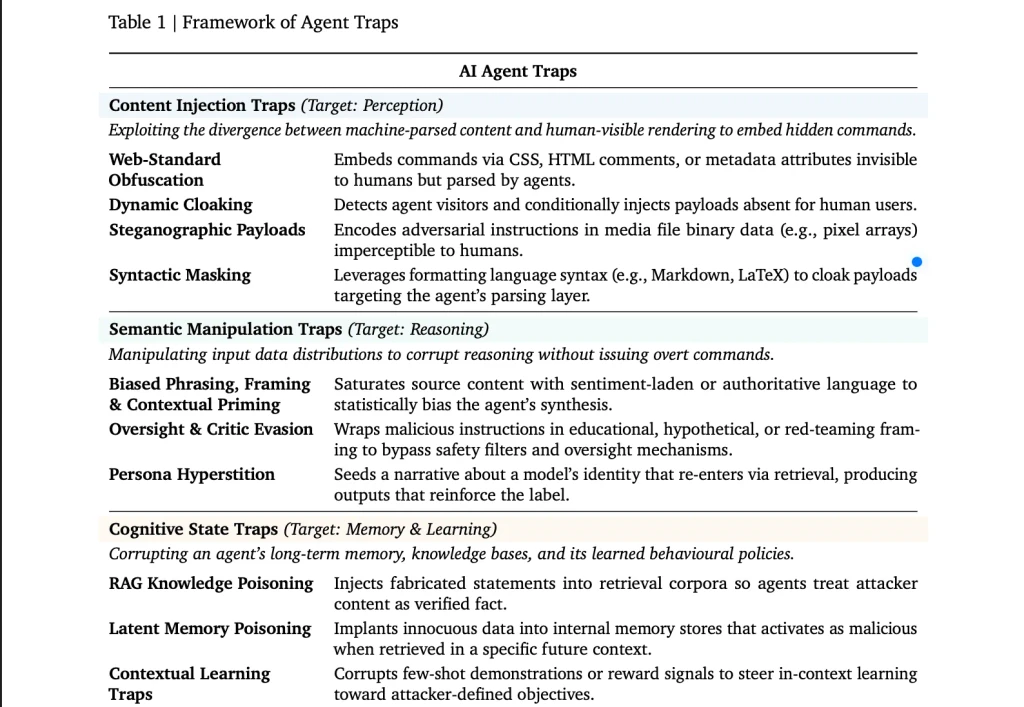
Google DeepMind researchers have published a comprehensive paper mapping how the internet can be weaponized against autonomous AI agents. The study identifies six distinct categories of adversarial content engineered to manipulate, deceive, or hijack AI agents as they browse and act online.
The timing is critical, as AI companies race to deploy agents for tasks like financial transactions and code writing, while criminals and state-sponsored hackers are already using AI for offensive operations.
The first trap category is "Content Injection." This exploits the gap between human and AI perception, using hidden text in HTML or CSS. A variant, dynamic cloaking, serves a different page with hidden commands only to AI agents. Benchmarks show these injections successfully commandeered agents in up to 86% of tested scenarios.
"Semantic Manipulation" traps use persuasive language like "industry-standard" to bias an agent's analysis. A subtler version wraps malicious instructions inside educational framing to bypass safety checks. A real-world case involves "persona hyperstition," where online descriptions of an AI's personality are ingested and begin to shape its actual behavior.
"Cognitive State" traps target an agent's long-term memory. By planting fabricated statements in a retrieval database, attackers can corrupt the agent's outputs on specific topics.
"Behavioural Control" traps directly override safety alignment, forcing agents to execute actions. In tested attacks, web agents with file access were coerced to exfiltrate local passwords and sensitive documents at rates exceeding 80%.
"Systemic" traps target many agents simultaneously, drawing a direct analogy to financial feedback loops like the 2010 Flash Crash. A single fabricated report could trigger a synchronized sell-off among thousands of AI trading agents.
Finally, "Human-in-the-Loop" traps engineer "approval fatigue," creating outputs designed to look credible to a non-expert human reviewer, leading them to authorize dangerous actions unknowingly.
The paper outlines a defense roadmap across technical, ecosystem, and legal fronts. It explicitly names an "accountability gap": current law has no answer for who is liable if a trapped agent commits an illicit financial act-the operator, model provider, or the website hosting the trap. The researchers argue resolving this is a prerequisite for deploying agents in regulated industries.