Hewlett Packard Enterprise (HPE) has significantly expanded its AI portfolio, positioning itself as a full-stack provider for enterprises moving artificial intelligence from pilots into production.
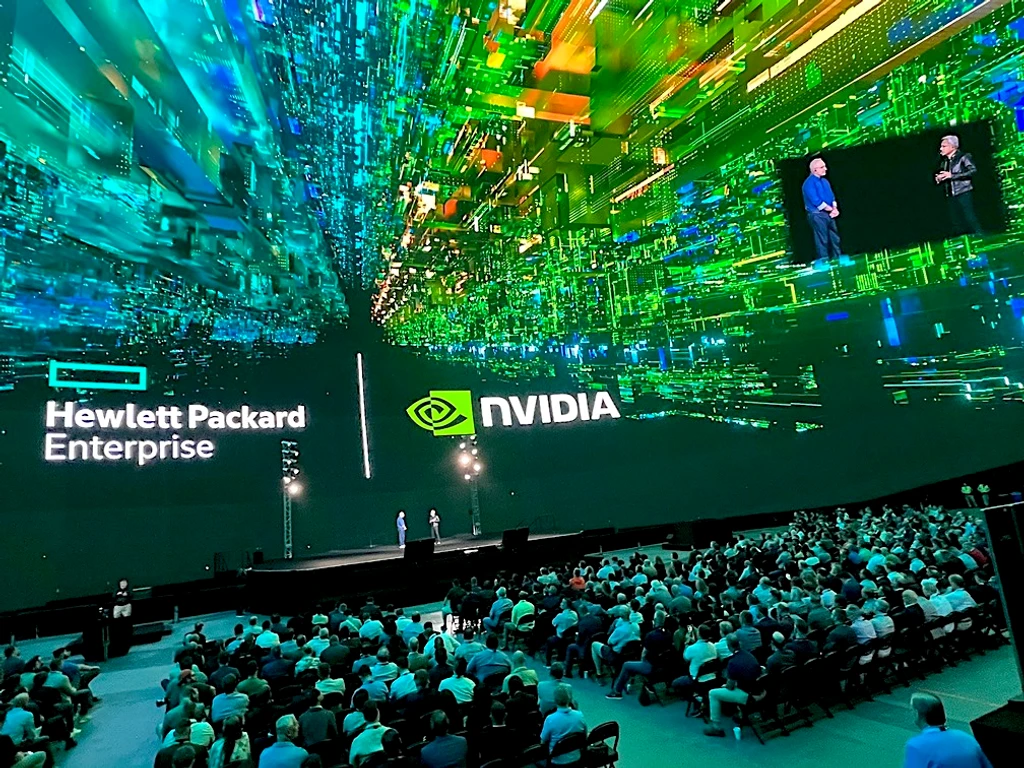
At Nvidia’s GTC conference, HPE introduced new systems spanning private cloud, edge computing, and large-scale AI factory infrastructure. The company emphasized repeatable, governed AI deployments over one-off experiments amid growing concerns about AI return on investment.
“Enterprises want predictable paths from infrastructure spending to business outcomes,” said Dale Brown, HPE’s global head of AI solution sales. “The real shift is from isolated projects to standardized, repeatable AI operations.”
HPE’s Private Cloud AI system-co-engineered with Nvidia-now scales to 128 GPUs and offers air-gapped configurations for regulated sectors like finance, defense, and healthcare. It also supports Nvidia’s AI-Q agentic blueprint and Omniverse digital twin software.
New hardware includes RTX Pro 6000 Blackwell GPUs across HPE AI factory systems and RTX Pro 4500 Blackwell GPUs in edge-focused ProLiant servers for small language models and analytics.
For model builders and sovereign AI initiatives, HPE launched the liquid-cooled Cray Supercomputing GX240 blade with up to 16 Nvidia Vera CPUs and the Nvidia Vera Rubin NVL72 rack-scale system for trillion-parameter models.
The HPE Compute XD700, based on Nvidia’s HGX Rubin NVL8 platform, doubles GPU density per rack and cuts inference token costs by up to 90% compared to prior Blackwell systems.
HPE is pairing these systems with multi-tenancy support via Nvidia MIG, Mission Control, Red Hat OpenShift, and end-to-end services-from data center design to operations.
On storage, HPE’s Alletra MP X10000 is now Nvidia-certified for up to 128-GPU configurations, addressing data pipeline bottlenecks.
“The goal is the right-sized AI factory,” Brown said, “from an air-gapped rack to a sovereign supercomputing cluster.”