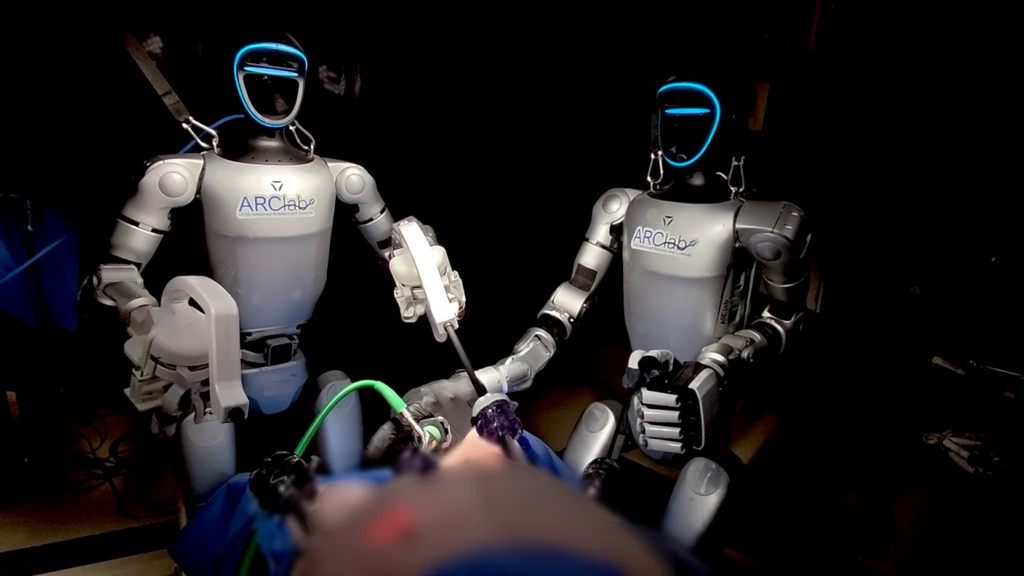
In a groundbreaking experiment, surgeons have teleoperated humanoid robots to perform live surgery for the first time, removing gallbladders from pigs in a preclinical trial published in Nature.
Researchers at the University of California San Diego controlled Unitree G1 humanoid robots, nicknamed "Surgie," to complete two minimally invasive procedures. This approach differs from autonomous surgical systems; human surgeons directly controlled the robots' movements remotely.
The potential application is significant. Such a system could provide access to robotic-assisted surgery in smaller hospitals or remote clinics that cannot afford expensive, specialized systems like Intuitive Surgical's da Vinci, which can cost millions.
"It’s a fraction of the cost and it takes a fraction of the space in an operating room," said Shanglei Liu, an assistant professor of surgery at UC San Diego. "So it’s easy to deploy, anywhere from rural areas, to the battlefield, and even to space."
The Unitree G1 robot, made by a Chinese company, is far cheaper than established surgical systems. However, the experiment revealed current limitations. The surgeries took much longer due to frequent pauses for recalibration, and the robots' compact size limited their operational reach.
The team is now working to improve the system. The ultimate goal includes creating an autonomous surgical assistant that could work alongside human surgeons, potentially expanding access to critical procedures globally.