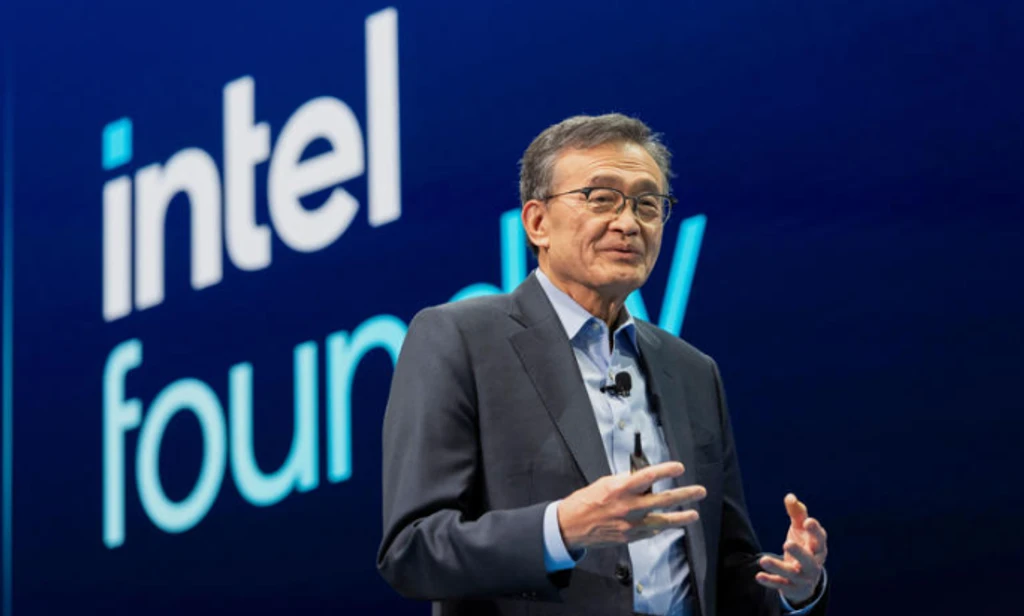
Intel Corp. has surpassed analyst expectations, signaling a turnaround for the chipmaker under CEO Lip-Bu Tan.
The company reported first-quarter earnings of 29 cents per share, significantly exceeding Wall Street's forecast of one cent. Revenue for the period reached $13.58 billion, also outperforming the predicted $12.42 billion.
Intel's stock price jumped over 20% in late trading, continuing its strong performance this year with an 81% year-to-date increase.
Much of Intel's recent momentum is attributed to U.S. government support, with the government becoming its largest shareholder last year. Nvidia and SoftBank Group Corp. have also made significant investments.
Evidence of a business turnaround is emerging. Intel's revenue rose 7% year-over-year, marking a reversal after declines in five of the previous seven quarters. The company forecasts continued revenue growth, projecting sales between $13.8 billion and $14.8 billion for the current quarter, well above analyst consensus.
This growth is largely fueled by Intel's data center business, which saw a 22% increase in revenue to $5.1 billion, driven by surging demand for CPUs in AI inference workloads. "Agentic AI," which uses autonomous workers for business tasks, requires computing power that can be more efficiently handled by CPUs than by the powerful GPUs typically used for other AI applications.
CEO Lip-Bu Tan stated, "The CPU is reinserting itself as the indispensable foundation of the AI era."
Despite revenue growth, Intel reported a net loss of $4.28 billion for the quarter, an increase from the previous year. The company maintains its own chip foundries for design and manufacturing, a strategy distinct from most rivals. Foundry revenue increased 16% to $5.4 billion.
Intel has launched new products including Xeon 6+ data center processors and Core Ultra Series 3 processors for personal computers. Google LLC has committed to purchasing millions of Intel's CPUs for its AI workloads.
New chips are being manufactured using Intel's advanced 18A process node at its Arizona facility. However, the company faces challenges securing external orders due to past delays and production issues.
Intel is developing its 14A process node, with potential collaboration with Elon Musk's Tesla Inc. and xAI Corp. This collaboration involves designing, fabricating, and packaging high-performance chips for Tesla's new Terafab chip complex. Musk indicated the 14A process could be mature by the time Terafab scales up.
Both Intel and Tesla acknowledge a global semiconductor supply shortage relative to demand. Analysts suggest that Intel's domestic manufacturing capabilities, combined with geopolitical factors, may attract more AI buyers. This trend, alongside demand for AI infrastructure, provides Intel with a more stable revenue base.