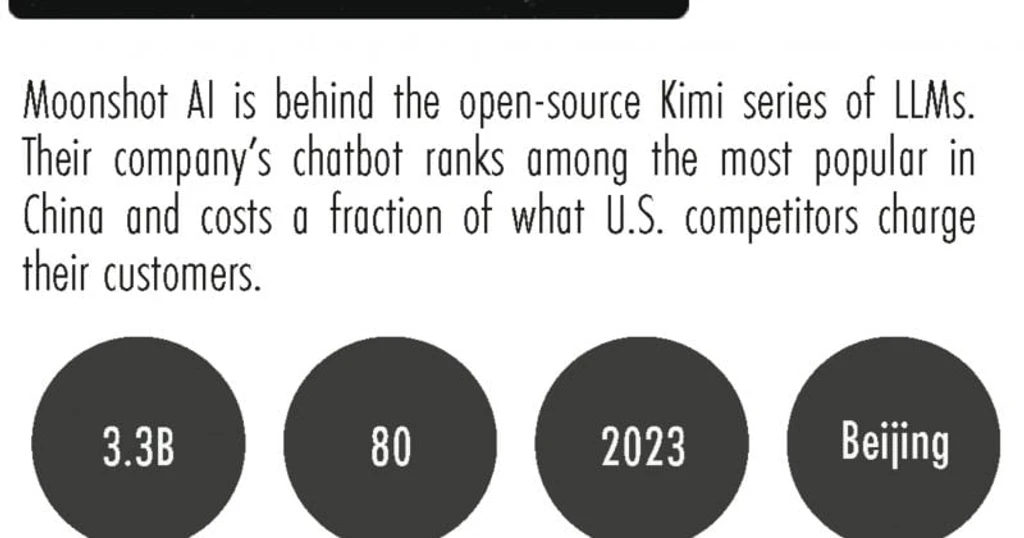
China's AI sector has again challenged Western dominance. Moonshot AI, a Beijing startup founded by Yang Zhilin, has unveiled Kimi K3.
The model, launched July 16-17, 2026, is billed as the world's largest open-weight AI model at launch, with 2.8 trillion parameters. More parameters generally mean greater capacity for learning complex patterns.
Independent evaluations placed Kimi K3 above OpenAI's GPT-5.6 on certain tasks, though Anthropic's Claude Fable 5 edged it out overall. The model showed particular strength in front-end coding, a capability that attracts enterprise buyers.
Moonshot priced its API at $3 per million input tokens and $15 per million output tokens. The model supports a 1-million-token context window, allowing it to process very long documents without losing context.
Moonshot plans to fully open-source Kimi K3 by late July 2026, allowing any developer or company worldwide to download, modify, and deploy it without licensing fees.
The announcement triggered a familiar market reaction: semiconductor stocks fell as traders questioned whether massive U.S. AI infrastructure investments would generate proportional returns. This mirrors the earlier impact from China's DeepSeek model.
Moonshot has emphasized efficiency as central to its development philosophy. The company's ability to achieve this scale despite chip constraints concerns U.S. AI executives.
Kimi K3 is not Moonshot's first product in Western markets. Previous versions were adopted by U.S. firms including Cursor and DoorDash. Yang Zhilin founded Moonshot with a research-first approach, and the jump to 2.8 trillion parameters represents a significant scale-up.
For investors, the implication is clear: if frontier AI models can be built more cheaply than assumed, demand projections for high-end AI chips may need revision. Nvidia and its peers have benefited from the assumption that cutting-edge models require massive, expensive hardware.