Nvidia, in collaboration with Carnegie Mellon University and UC Berkeley, has unveiled ENPIRE, a groundbreaking framework allowing AI coding agents to train physical robots without human supervision. This system enables agents running models like Codex, Claude Code, and Kimi Code to execute the full research loop directly on hardware.
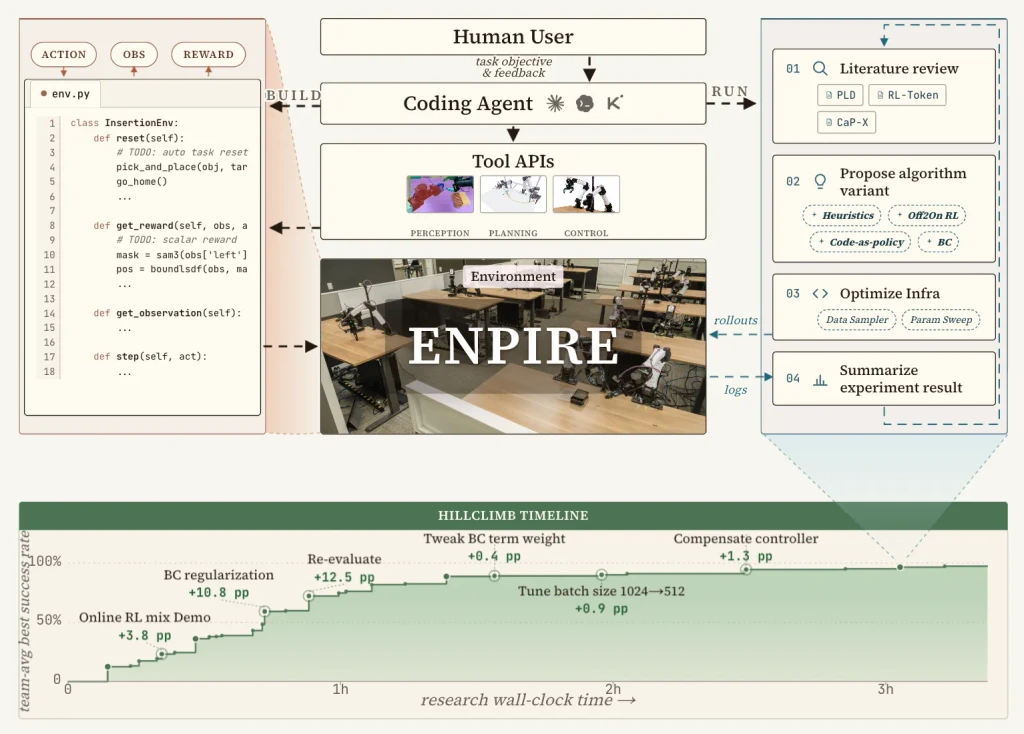
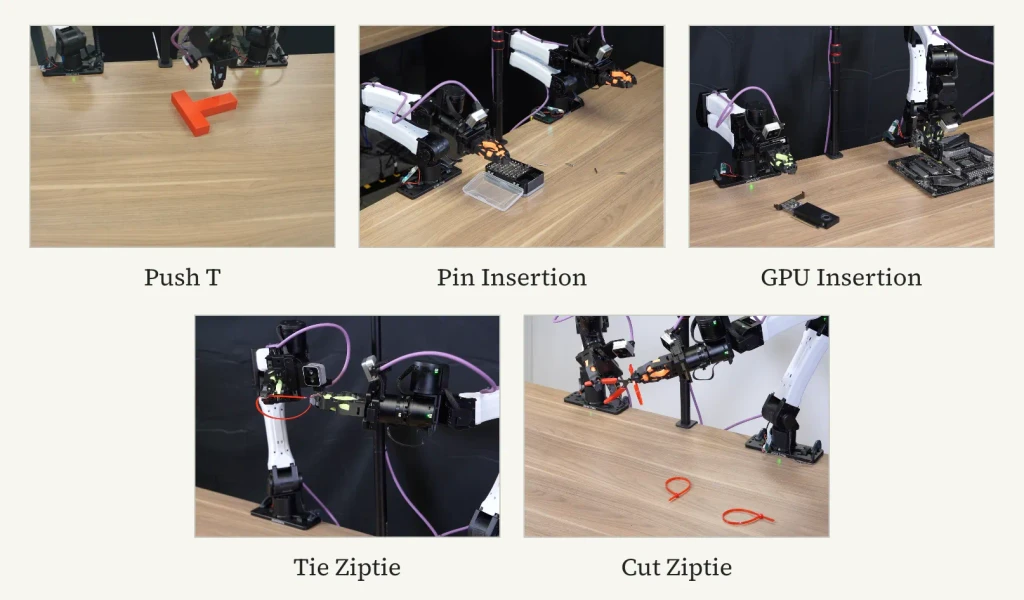
The technology moves autonomous research from digital simulations to the physical world. While previous systems reset failed experiments instantly on screen, ENPIRE manages real-world variables like friction and hardware resets. After an initial human-guided setup for safety protocols and reward functions, the agents independently search literature, select training methods, and rewrite code to master tasks such as pin insertion and GPU seating.
Operational efficiency scales significantly with fleet size. In tests across eight bimanual robot stations, agents shared progress via Git, reducing mastery time for complex tasks by more than half compared to single-unit training. The system achieved a 99% success rate across four distinct real-world benchmarks, outperforming comparable human-in-the-loop methods.
Jim Fan, co-lead of Nvidia’s GEAR Lab, described this as the first instance of AutoResearch in the physical world. Unlike Alibaba’s concurrent Qwen-Robot Suite which focuses on software foundations, Nvidia is validating end-to-end agent autonomy on proprietary hardware. This development signals a pivotal shift where physical robotics becomes the primary arena for competitive AI coding agents.