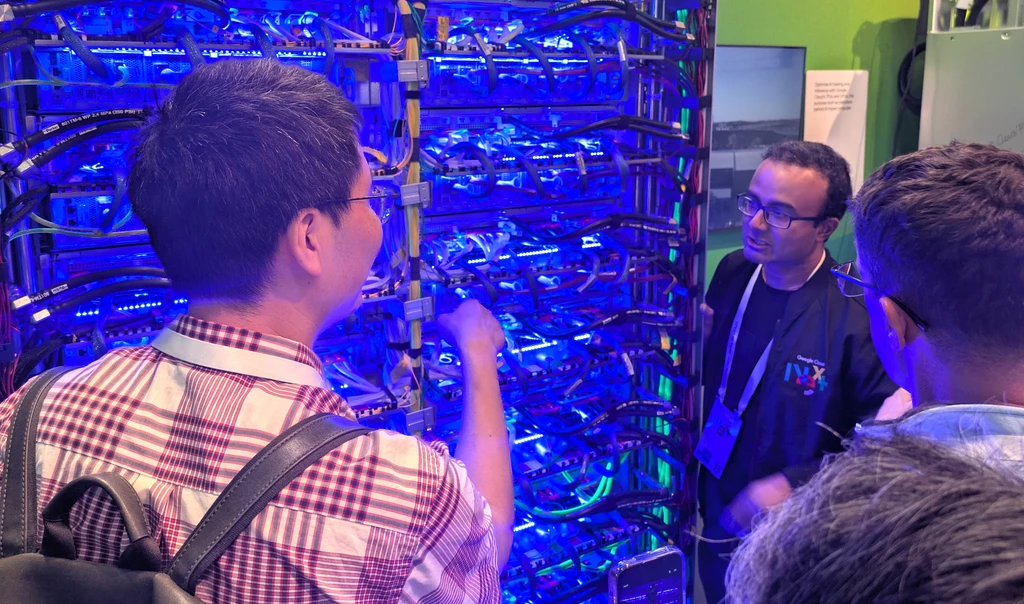
Nvidia and Google Cloud have intensified their decade-long partnership, unveiling a comprehensive "AI factory" at Google's Cloud Next event. This collaboration integrates Google's AI Hypercomputer infrastructure with Nvidia's cutting-edge solutions, including the Blackwell platform, open models, and AI tooling for agentic and physical applications.
The expanded offering provides customers with a streamlined path from AI experimentation to large-scale deployment. Google Cloud is enhancing its AI Hypercomputer architecture with new Nvidia-powered instances, featuring Grace Blackwell systems and the upcoming A5X instance. These are designed for large-scale AI training and inference.
Google also introduced Virgo Networking, a data center network fabric optimized for massive AI operations. This fabric will support the Vera Rubin A5X instance, enabling scaling across numerous graphics processing units.
Furthermore, Nvidia's Omniverse libraries and the open-source Isaac Sim robotics simulation framework are now accessible on Google Cloud Marketplace. This allows developers to create digital twins and robotics simulation pipelines for pre-deployment validation.
The partnership spans cloud, on-premises, and edge environments, offering a unified platform from development to production.
This full-stack collaboration leverages Nvidia's GPUs across Google Cloud services, integrated with Google's networking and storage. Managed services provide native observability, simplifying AI consumption.
Google operates one of the world's largest accelerated infrastructure deployments, exceeding a million Nvidia GPUs. This scale facilitates faster deployment of new GPU generations and ensures ample capacity for enterprise AI workloads.
Nvidia's shift from general-purpose to accelerated computing, focusing on parallel data processing and comprehensive platforms rather than just chips, aligns seamlessly with Google's AI Hypercomputer strategy. This offers customers a programmable, horizontally broad solution.
Nvidia's advantage lies in its broad ecosystem support via CUDA, enabling diverse workloads from LLMs to scientific HPC. Its cross-industry, multicloud portability contrasts with proprietary ASICs, making it an attractive choice for enterprises requiring flexible distribution.
For Google Cloud, this partnership enhances its AI infrastructure appeal by offering broad ecosystem support. It allows for faster innovation by combining Nvidia's GPU roadmap with Google's own infrastructure fabric.
For customers, the benefits include reduced platform risk, a faster path from concept to production, and operational maturity through managed services. This lowers organizational friction for AI adoption.
The Nvidia-Google stack provides a reference design for building AI factories, offering a unified platform for training, inference, and simulation, consumable as a service or emulated on-premises.
This integration supports agentic and physical AI, moving beyond chatbots to agents that interact with the physical world. The extensive ecosystem leverage allows enterprises to adopt best-of-breed components without hardware constraints, accelerating experimentation and iteration.
This co-designed AI Hypercomputer positions Google Cloud as a significant player in the AI era, offering enterprises and startups a powerful, purchasable product.