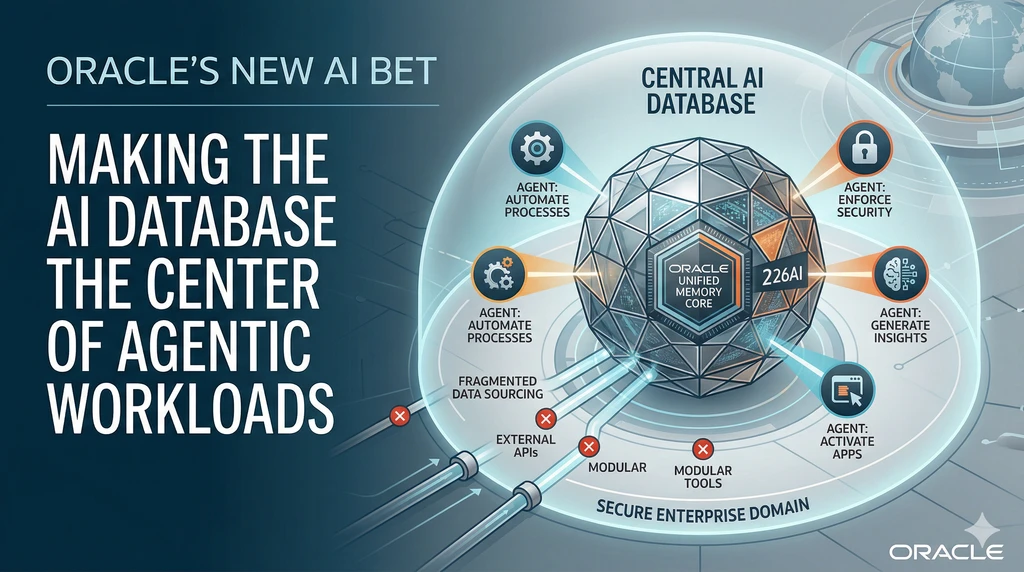
In the race to define enterprise artificial intelligence, Oracle is taking a different approach. Instead of focusing on models, it's positioning the database as the core of agentic AI. At its recent AI World Tour, Oracle argued that the future of AI depends not just on agents, but on how they interact with data.
The company claims the bottleneck in enterprise AI isn't the model, but the ability to ground outputs in real, governed data. Most corporate data environments are fragmented, making it difficult to scale AI systems. Oracle’s solution is to embed agentic AI directly into the database, collapsing complex architectures and reducing latency.
A key part of this strategy is a unified memory layer that allows AI agents to operate on live data in its native form. This approach also brings agent development inside the enterprise, offering more control and security. Oracle is extending its security features to include row-level access controls tied to both user and agent identities.
By integrating AI with existing data environments, Oracle aims to minimize movement and reduce fragmentation. Its agentic AI runs across major cloud platforms, allowing enterprises to activate AI where their data already resides.
The industry is splitting between composability and convergence. Oracle favors convergence, betting that simplicity will win out over modularity for large enterprises. As AI moves from prototypes to production, managing data becomes critical, and Oracle is positioning the database as the control plane for agentic AI.