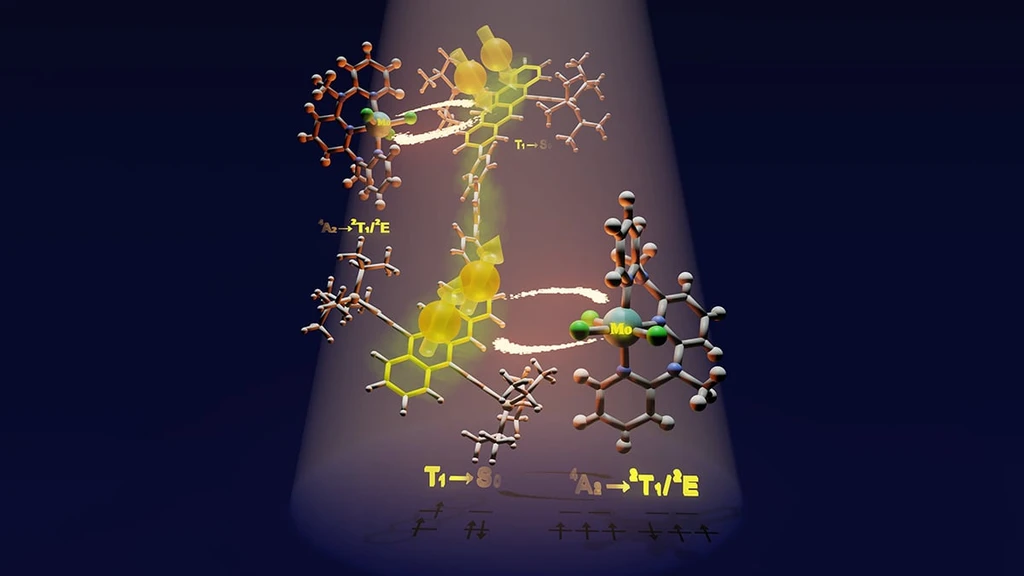
Scientists have achieved a remarkable 130 percent quantum yield in solar energy conversion, a significant leap in solar cell technology. This breakthrough utilizes a process called singlet fission, which splits the energy harvested from a single incoming light photon into two, powering two excited states instead of the usual one. This novel approach, developed by an international team led by researchers from Kyushu University, aims to bypass the theoretical Shockley-Queisser limit that typically caps solar cell efficiency around 33 percent.
The technique employs an organic molecule, tetracene, to facilitate singlet fission. A key innovation involves combining tetracene with molybdenum complexes. This prevents excess energy loss as heat and allows the split excitons to be captured and utilized. The molybdenum acts as a spin-flip emitter, stabilizing the energy before converting it into light.
While this represents an early laboratory success, the next critical steps involve developing a solid-state material suitable for integration into solar panels. Researchers acknowledge the challenges in creating a stable and efficient system. However, this proof-of-concept opens a clear pathway to developing solar panels that significantly exceed current efficiency benchmarks, a development crucial for advancing renewable energy and combating climate change.