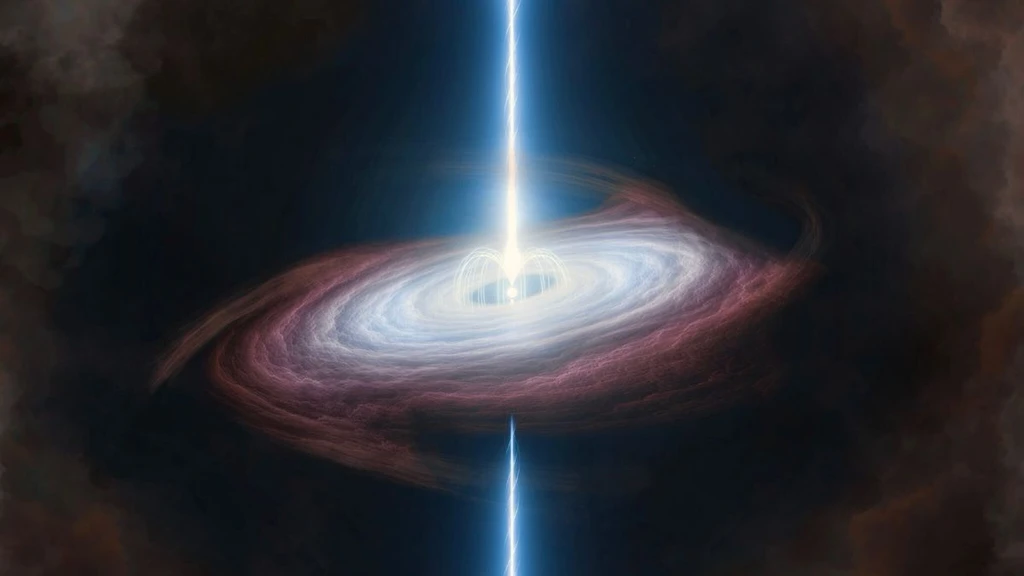
Astronomers have witnessed the birth of a magnetar-one of the universe's most powerful magnets-for the first time, embedded within a superluminous supernova designated SN 2024afav. The discovery confirms theoretical models linking magnetars to unusually bright stellar explosions.
Detected in December 2024, SN 2024afav exhibited a light curve that brightened and dimmed four times after peak luminosity, defying typical supernova behavior. These oscillations, dubbed "chirps," align precisely with predictions from Einstein’s theory of general relativity, specifically the Lense-Thirring effect.
The chirps suggest a wobbling accretion disk around the newborn magnetar, which spins every 4.2 milliseconds and possesses a magnetic field roughly 300 trillion times stronger than Earth’s. This wobble modulates the light observed from Earth, effectively turning the system into a strobing cosmic lighthouse.
"This is definitive evidence for a magnetar forming as the result of a superluminous supernova core collapse," said Alexei Filippenko of UC Berkeley. Joseph Farah, lead author, confirmed only Lense-Thirring precession perfectly matched the timing of the observed wobbles.
While not all superluminous supernovas are powered by magnetars-some driven by dust cocoons-the team plans to use Chile’s Vera C. Rubin Observatory to identify how common such events are across the cosmos.