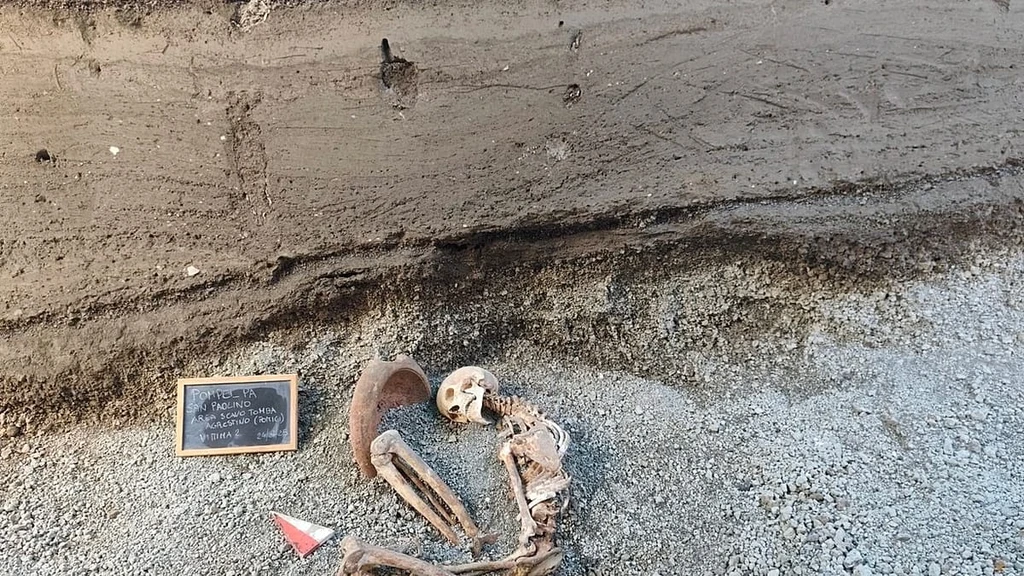
New excavations in Pompeii's Porta Stabia necropolis have unearthed the remains of two men who perished during the 79 AD eruption of Mount Vesuvius. Their positions reveal distinct phases of the catastrophe: one victim was likely killed instantly by a pyroclastic flow, while the other, an older man, died hours earlier from falling lapilli (volcanic debris) while attempting to flee the city.
Archaeologists found an earthenware mortar, fractured and likely used for protection, near the older man's body. He also carried a ceramic oil lamp, possibly for navigating darkness, an iron ring, and ten bronze coins. These everyday objects offer a glimpse into a desperate, yet organized, escape attempt amidst chaos.
In a significant development for archaeology, the Park of Pompeii, in collaboration with the University of Padua, has utilized artificial intelligence to digitally reconstruct the victim's final moments. This experimental model combines algorithms and advanced photo-retouching techniques to create a scientifically-grounded and accessible visual representation of the event. Italian Culture Minister Alessandro Giuli highlighted AI's role in protecting heritage and narrating ancient life, while Park director Gabriel Zuchtriegel emphasized AI's potential to enhance archaeological data analysis and classical studies. Experts note that AI acts as a powerful tool, broadening and deepening archaeological insights under specialist guidance, making the past more accessible without compromising rigor.