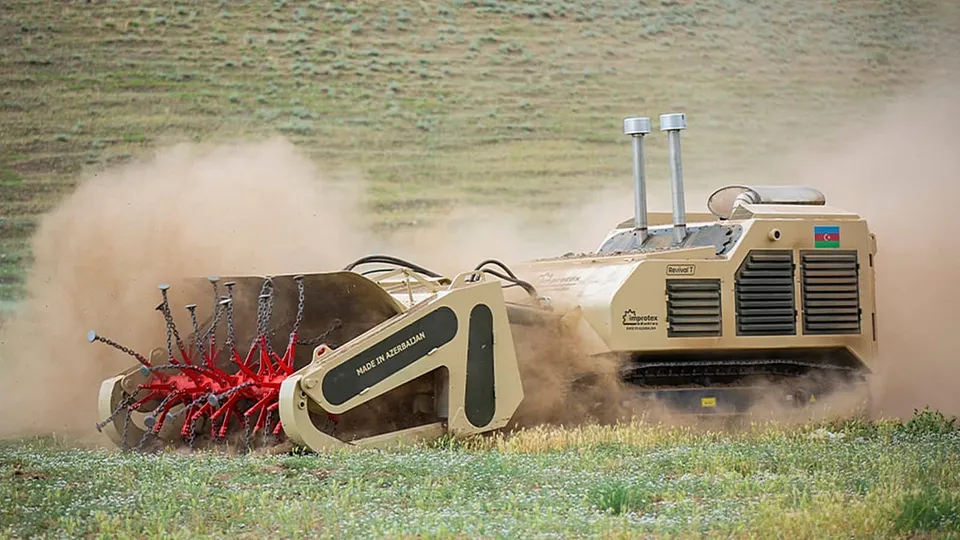
Countries grappling with landmine contamination are increasingly deploying remote-controlled demining vehicles to accelerate clearance operations. These unmanned systems significantly reduce the risk to human deminers while covering vast areas more effectively.
Azerbaijan is at the forefront, with its firm ImProtex developing and ANAMA operating these advanced machines. Designed for high-risk environments, they tackle areas where manual clearance is slow and perilous, adhering to International Mine Action Standards.
Vice President of ImProtex, Gunel Alakbarova, highlighted the persistent humanitarian and security challenge of mines left from past conflicts, impacting land use and safety. The latest model, Revival T, is engineered to neutralize both anti-personnel and anti-tank mines across rugged terrain.
Mechanical demining machines offer the highest throughput, clearing 500 to 2,000 square meters daily, a stark contrast to individual deminers clearing 20-50 square meters. Automation is key to reducing casualties, as robotic systems minimize manual labor and enhance clearance speed.
This technological shift not only saves lives but also accelerates post-conflict recovery, enabling reconstruction projects and the return of displaced communities. Azerbaijan has showcased its demining technology internationally, including at UMEX 2026 in Abu Dhabi.
Since 2020, Azerbaijan has cleared over 240,000 hectares and neutralized more than 227,000 mines. The government has allocated significant funds for mine action, and international partners, including the EU, are providing substantial assistance.
Azerbaijan is also sharing its expertise internationally, supplying unmanned demining vehicles and training to Ukraine, where mine contamination poses a critical threat to civilian safety and economic recovery.
Globally, landmines remain a serious issue, with thousands killed or injured annually. These devices can remain active for decades, restricting access to farmland and essential services. Organizations like UNMAS and UNDP emphasize that mines are a major obstacle to post-conflict recovery. Addressing this pervasive threat requires sustained investment and long-term collaboration.