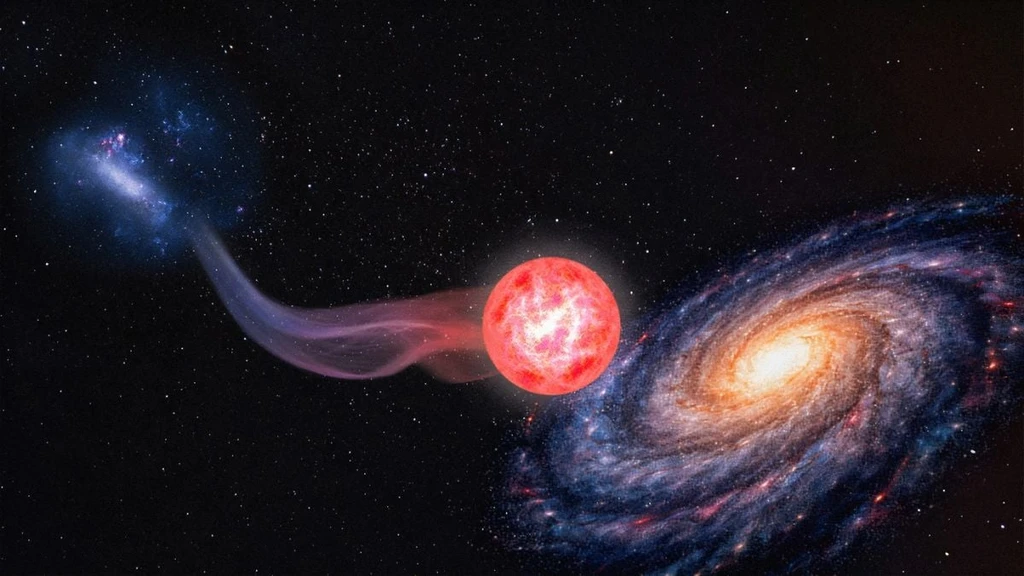
Astronomers have identified the purest ancient star found to date within our own Milky Way galaxy. This star, designated SDSS J0715-7334, is a remarkably unpolluted relic from the early Universe, likely formed from gas enriched by one of the first supernova explosions.
Now a red giant nearing the end of its life, the star provides crucial insights into cosmic history. Cosmologist Alexander Ji stated that these pristine stars serve as windows into the dawn of stars and galaxies. Following the Big Bang, the Universe was filled with a plasma fog. As it cooled, neutral hydrogen and helium formed, giving rise to the first stars, known as Population III. Elements heavier than helium were only widely distributed after these early stars died.
Stars are powered by fusion, creating heavier elements. In astronomy, elements heavier than helium are termed metals. While fusion primarily stops at iron, heavier elements are forged in supernova explosions, seeding space for future star formation. All stars measured show some degree of metal enrichment, but SDSS J0715-7334 exhibits exceptionally low metallicity, with its composition suggesting enrichment from Population III stars.
Astronomer Kevin Schlaufman noted that Population III stars have never been observed, making Population II stars like SDSS J0715-7334 highly sought after for studying the early stellar generations. The star was discovered almost by accident by Ji and his students using the Sloan Digital Sky Survey.
Upon closer examination, SDSS J0715-7334 revealed a composition of almost entirely hydrogen and helium, with a metallicity 40 times lower than the next most iron-poor star known. Notably, its extremely low carbon content suggests formation influenced by cosmic dust, a pathway seen only once before. This indicates it formed in an intermediate regime where dust, from Population III supernovae remnants, likely aided gas collapse due to insufficient carbon for standard cooling.
Its trajectory suggests the star originated not from the Milky Way, but from the Large Magellanic Cloud, a dwarf galaxy. This implies the Large Magellanic Cloud may harbor more such ancient stars awaiting discovery. Schlaufman suggests these galaxies might contain a higher proportion of ultra-metal-poor stars than the Milky Way.