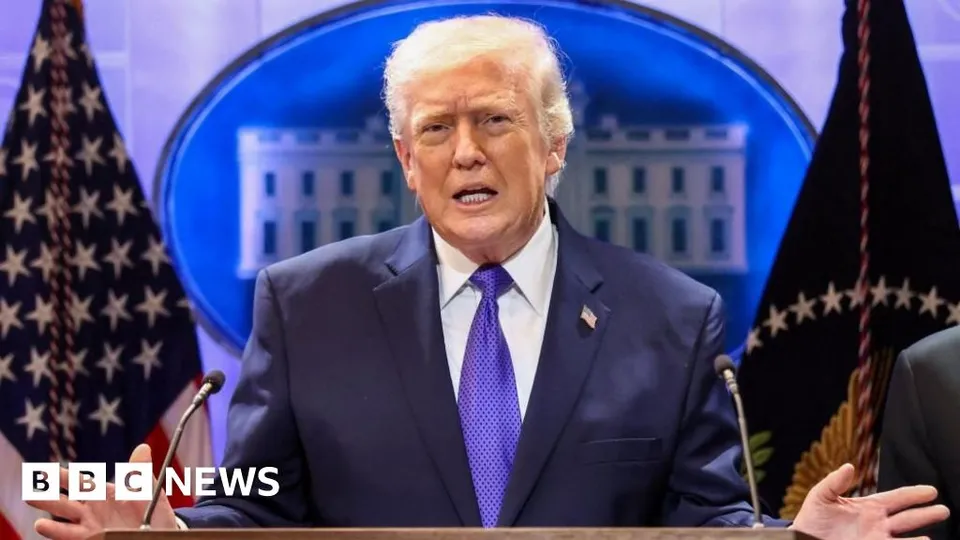
President Donald Trump has unveiled a new 10% global tariff, replacing import taxes previously invalidated by the Supreme Court. The president declared the court's ruling "terrible," criticizing the justices for rejecting his trade policy.
The Supreme Court, in a 6-3 decision, ruled that the White House had exceeded its presidential authority with the global tariffs announced last year. This decision offered a significant victory to businesses and U.S. states that challenged the duties, potentially leading to billions in tariff refunds and introducing new global trade complexities.
Speaking from the White House, Trump suggested that tariff refunds would face legal challenges, anticipating years of court battles. He stated his intention to utilize other legal avenues to advance his tariff agenda, which he asserts promotes U.S. investment and manufacturing.
The court's decision focused on import taxes levied on goods from numerous countries, initially targeting Mexico, Canada, and China before expanding to dozens of trade partners. The White House had invoked the International Emergency Economic Powers Act (IEEPA) of 1977, which grants the president power to "regulate" trade during emergencies.
However, the measures faced opposition from domestic and international firms concerned about increased shipping costs and higher consumer prices. Lawyers for challenging states and businesses argued that the IEEPA did not grant the president the explicit power to impose tariffs. Chief Justice John Roberts, in his opinion, concurred that if Congress intended to delegate such tariff powers, it would have done so explicitly, as is customary in other tariff statutes.
The ruling was supported by the court's liberal justices and two justices nominated by Trump, Amy Coney Barrett and Neil Gorsuch. Dissents came from conservative justices Clarence Thomas, Brett Kavanaugh, and Samuel Alito. Trump expressed disappointment with the Republican appointees who voted against his policy, calling them "fools and lap dogs."
Wall Street saw a positive reaction to the ruling, with the S&P 500 closing up approximately 0.7%. Businesses across the U.S. cautiously welcomed the decision. However, the anticipated refunds and relief from tariff costs may be delayed.
Trump's new 10% tariff is imposed under Section 122, a previously unused law allowing tariffs up to 15% for 150 days, after which Congress must intervene. Analysts anticipate the White House may explore other provisions, such as Section 232 and Section 301, which permit import taxes for national security and unfair trade practice reasons. These provisions were previously used for tariffs on steel, aluminum, and cars, which were unaffected by the recent court ruling.
According to a White House official, countries with trade agreements with the U.S., including the UK, India, and the EU, will now be subject to the new 10% tariff under Section 122, superseding their previously negotiated rates. Experts view the situation as increasingly complex and uncertain. Major trade partners have reacted with muted responses, stating they are carefully analyzing the ruling. Hundreds of firms have filed lawsuits contesting the tariffs to secure refunds, but the court's decision does not directly mandate refund procedures, likely deferring the process to the Court of International Trade. Some economists warn that litigation costs could hinder smaller firms from recouping funds, while legal experts suggest companies can be confident in eventual refunds, though the timeline remains uncertain.