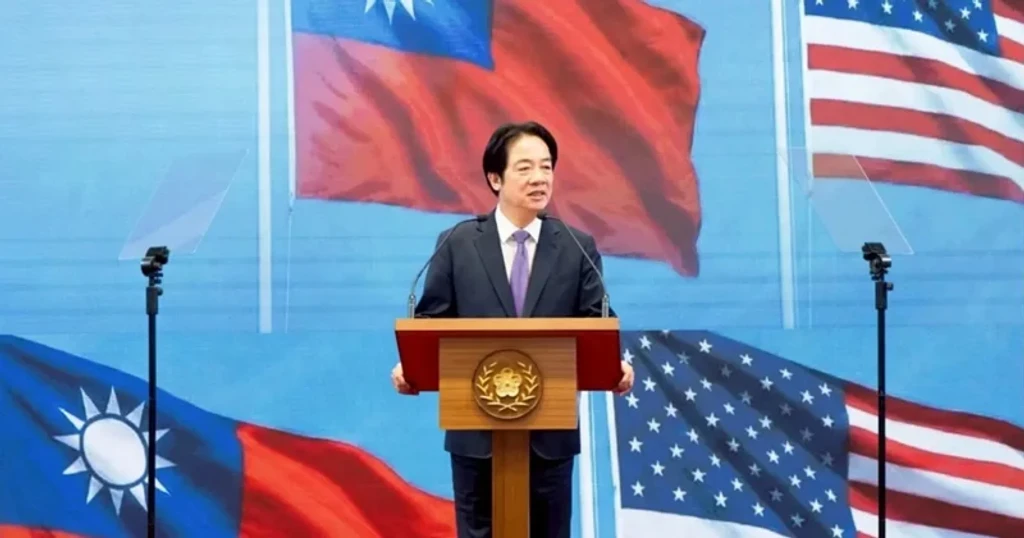
Taiwan’s government has signaled openness to a phone call between President Lai Ching-te and US President Donald Trump, a move that would mark the most significant direct presidential contact between Washington and Taipei in years. The last time Trump called a Taiwanese president, in December 2016, it shattered nearly four decades of diplomatic protocol and sent shockwaves through global markets.

China considers Taiwan a breakaway province, and any direct leader-level contact between Washington and Taipei is viewed in Beijing as a challenge to its sovereignty. President Xi Jinping has warned that mismanagement of the Taiwan issue could result in outright conflict. Trump reportedly expressed intentions to contact Taiwan’s president while traveling on Air Force One.
The 2016 Trump-Tsai call covered politics, economy, and security in the Asia-Pacific region. A conversation with Lai would likely touch similar themes, but the geopolitical landscape has shifted considerably, with tensions over Taiwan’s semiconductor dominance, AI supply chains, and military posturing in the Taiwan Strait all escalating.
Taiwan is the beating heart of the global semiconductor supply chain. TSMC manufactures the vast majority of the world’s most advanced chips, powering AI data centers, crypto mining operations, and GPU infrastructure. Any disruption to Taiwan’s stability ripples directly into the hardware backbone of the digital economy. For crypto, a significant escalation in US-China tensions over Taiwan would threaten chip supply timelines, potentially increasing costs for mining hardware and triggering broad risk-off sentiment that has historically hammered digital assets alongside equities.
China’s response to increased US-Taiwan engagement has followed a predictable pattern. Beijing condemned a proposed $14 billion US arms package for Taiwan, and military exercises near Taiwan have increased. For traders and investors, the question is how aggressively Beijing will respond.
Geopolitical risk is the variable that quantitative models struggle with most, and Taiwan sits at the intersection of nearly every major macro theme affecting crypto: US-China trade relations, semiconductor supply constraints, AI infrastructure spending, and the broader question of whether risk assets can sustain rallies amid escalating great-power competition. Bitcoin has historically shown a complicated relationship with geopolitical shocks. Short-term sudden escalations trigger sell-offs; longer-term, sustained uncertainty has sometimes bolstered the 'digital gold' narrative.
The semiconductor angle deserves particular attention from miners and infrastructure investors. Any scenario that disrupts TSMC’s production would constrain chip availability, raising break-even prices for mining operations. Investors should also watch how stablecoin flows respond if tensions escalate. Previous US-China friction has corresponded with increased stablecoin activity in Asian markets, as capital seeks channels outside traditional banking infrastructure.