
Data from Bitwise indicates that investors holding Bitcoin for a minimum of three years have historically seen losses shrink to just 0.70%. This suggests that a long-term strategy is crucial for mitigating risk in the volatile cryptocurrency market.
Analysis of Bitcoin’s price history from July 2010 to February 2026 shows that nearly all three-year holding periods have resulted in profit. The risk of loss further diminishes with longer holding periods, falling to 0.2% over five years and 0% over ten years.
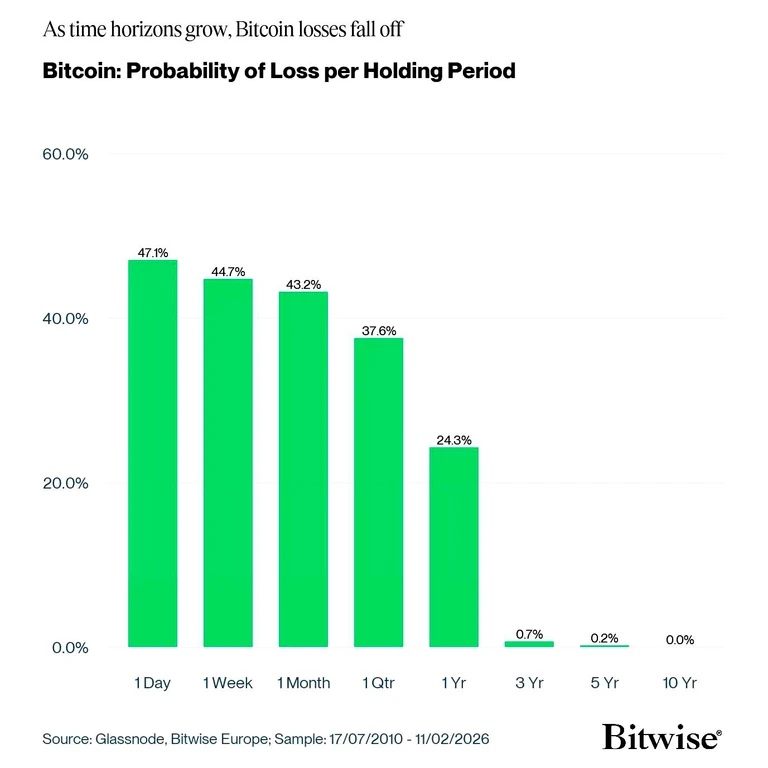
Conversely, short-term traders face considerably higher risks. Intraday buyers, for example, had a 47.1% chance of experiencing losses, with probabilities remaining elevated for holding periods of one week (44.7%), one month (43.2%), and one year (24.3%).
The realized price metric reinforces these findings, showing that investors who held Bitcoin for three to five years were still in profit, with an approximate 90% gain even after a recent 50% price correction from its October 2025 high.
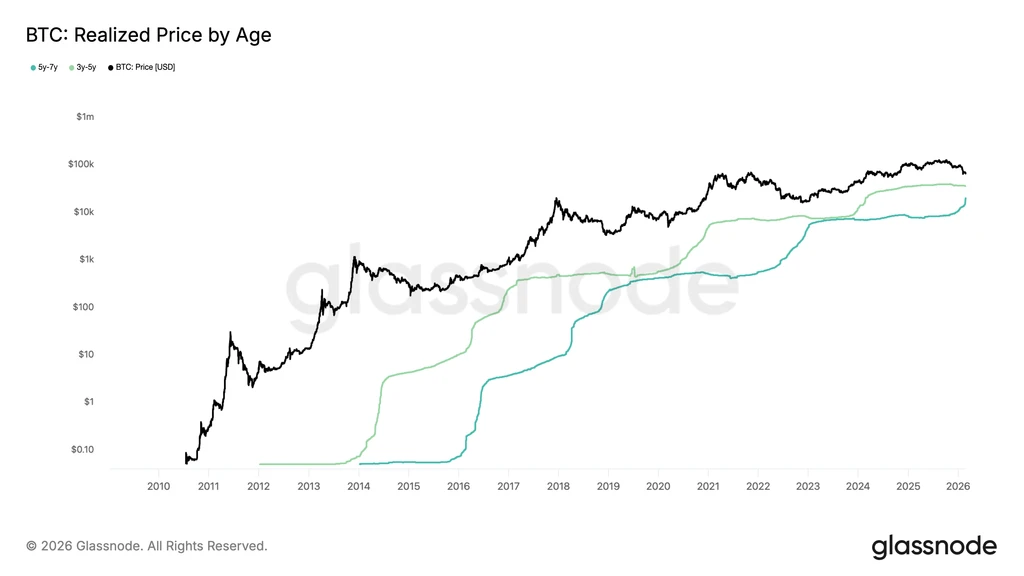
However, investors who acquired Bitcoin in the past two years are largely underwater. The cost basis for those holding for six months to a year was around $101,250, resulting in a 35% unrealized loss. Those holding for one to two years had a cost basis of $78,150, facing about a 15% unrealized loss. This pattern underscores the benefit of extended holding periods during market downturns.
Longer-term forecasts for Bitcoin remain optimistic, with price targets for 2026-2027 ranging from $100,000 to $150,000 in bullish scenarios. Analysts at Bernstein maintain a $150,000 price call for 2026, citing modest outflows from spot Bitcoin ETFs despite price drops. Standard Chartered projects a potential recovery to $100,000 by the end of 2026, following a possible dip to $50,000. Another forecast points to $122,000 by early 2027 based on historical average return models.