
A whitepaper published yesterday by Google Quantum AI shows a fast-clock quantum computer could derive a Bitcoin private key from a public key in approximately nine minutes. Bitcoin settles a block every ten minutes.
That leaves, on average, a one-minute margin between the system working and an adversary hijacking live transactions from the mempool before they confirm. This research violently accelerates the timeline, meaning the entire supply of Bitcoin is now at risk.
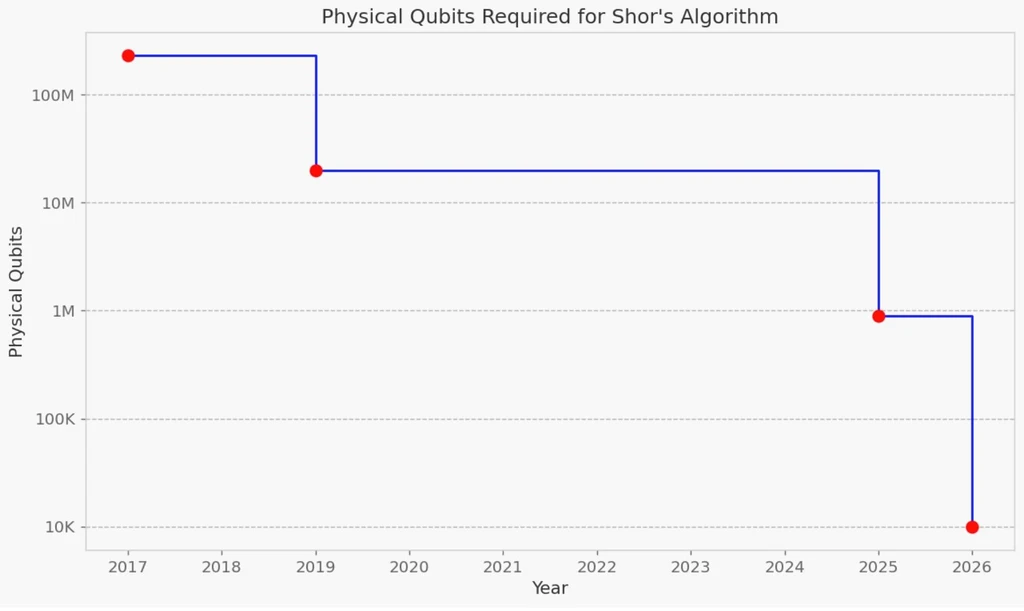
Google's paper brings the physical requirement down to fewer than half a million qubits, using just 1,200 logical qubits-a threshold achievable in the near-term. Google has reportedly moved up its own quantum timelines to 2029.
Researchers from Oratomic announced a parallel breakthrough using neutral-atom hardware. Two separate technological tracks are compressing the required resources by orders of magnitude.
The quantum threat is not a single moonshot; superconducting, photonic, neutral-atom, and ion-trap architectures represent different engineering roadmaps. Only one needs to succeed.
Migrating a decentralized network like Bitcoin is not like flipping a switch. Post-Quantum Cryptography requires larger digital signatures, increasing bandwidth and storage. Implementing this requires a hard fork, and the logistics of moving assets are staggering.
If we wait until Q-Day-when a cryptographically relevant quantum computer is publicly confirmed-to begin, it will be too late. Executives, institutions, stablecoin issuers, and protocol teams must acknowledge the risk profile has fundamentally changed. The world needs proactive migration strategies and an industry-wide mandate to upgrade before the first silent theft occurs.