
Iranian-linked wallets transferred more than $3.84 billion through the crypto exchange CoinEx since 2019, according to blockchain analytics firm TRM Labs. The flows highlight how the platform became a key conduit for circumventing U.S. economic sanctions.
Nearly $2.7 billion of that total moved between CoinEx and Nobitex, Iran’s largest domestic exchange-an average of roughly $1 million per day since 2018. By 2024, CoinEx was Nobitex’s largest external counterpart, nearly nine times bigger than the next exchange. TRM Labs described the pattern as “inconsistent with independent market behaviour.”
The finding comes weeks after the U.S. Treasury sanctioned four Iranian crypto exchanges under its “Economic Fury” campaign. Treasury Secretary Scott Bessent said the department had seized $1 billion in crypto from Iranian platforms and wallets.
CoinEx denied any commercial relationship with the Iranian government or domestic exchanges, arguing that onchain fund flows do not prove knowledge of illicit activity.
Still, most major Iranian exchanges route 5% to 10% of their trading volume through CoinEx, suggesting a coordinated arrangement rather than organic adoption, TRM Labs said. CoinEx’s share of illicit transaction volume stands at nearly 8%, compared with 0.3% at other compliant exchanges.
The exchange’s affiliated mining pool, ViaBTC, accounted for another $154 million in traced exposure to Nobitex. It also supplied emergency liquidity after a $90 million hack of Nobitex in June 2025.
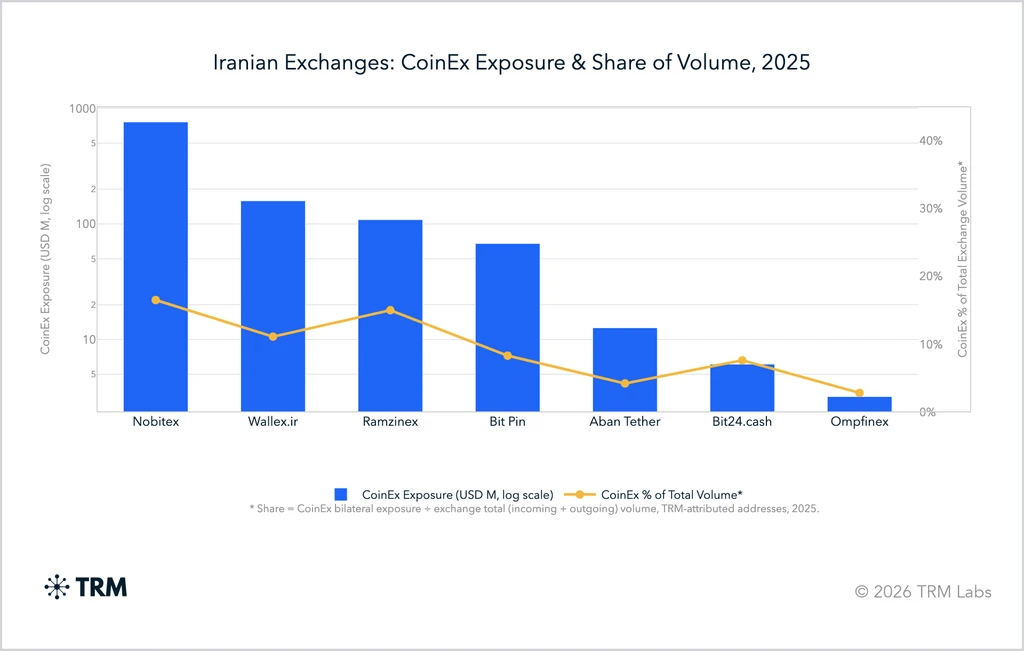
Iranian exchanges: CoinEx exposure & share volume, 2025. Source: TRM Labs
At the center of the pipeline is Nobitex, which handles about 50% of Iran’s crypto trading. The exchange has been linked to a family with ties to Supreme Leader Ali Khamenei. In January, the Office of Foreign Assets Control sanctioned UK-registered Zedcex and Zedxion, allegedly front companies for the Islamic Revolutionary Guard Corps.