Macro investor Jordi Visser argues Bitcoin's original purpose is returning as the Federal Reserve faces a new crisis shaped by high debt, oil price shocks, slowing growth, and weakening employment. In his analysis titled "D.O.G.E. 2.0," Visser says this mix leaves policymakers unable to impose the economic pain required for a traditional inflation fight.
Visser's framework focuses on supply-side stress, citing rising oil prices and AI-driven chip costs. He notes federal debt is now about 122.5% of GDP, roughly four times heavier than during the 1970s inflation era. The stock-market-capitalization-to-GDP ratio is also above 200%, indicating a far more financialized and fragile economy.
Visser points to recent employment data showing payrolls down and wage growth easing, making a renewed inflation offensive harder to justify. He cites Fed Chair Powell's comments about looking through energy shocks if expectations remain anchored.
Visser ties the current setup back to Bitcoin's creation in 2008-09, arguing its design was a direct response to a monetary system dependent on bailouts and intervention when stress becomes intolerable. He concludes Bitcoin does not require hyperinflation to validate its thesis; it only requires markets to believe each inflation fight will be shorter and each easing cycle will arrive sooner in a debt-heavy system.
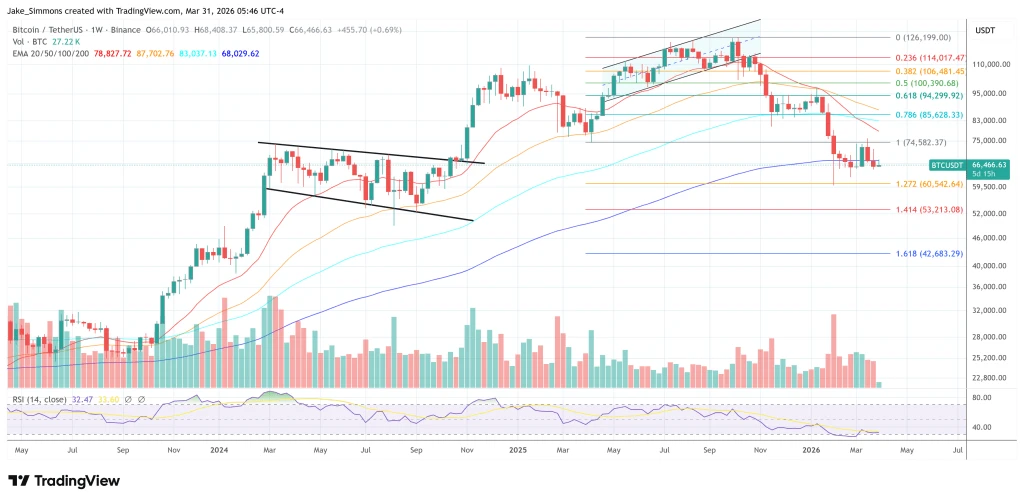
At press time, Bitcoin traded at $66,466.