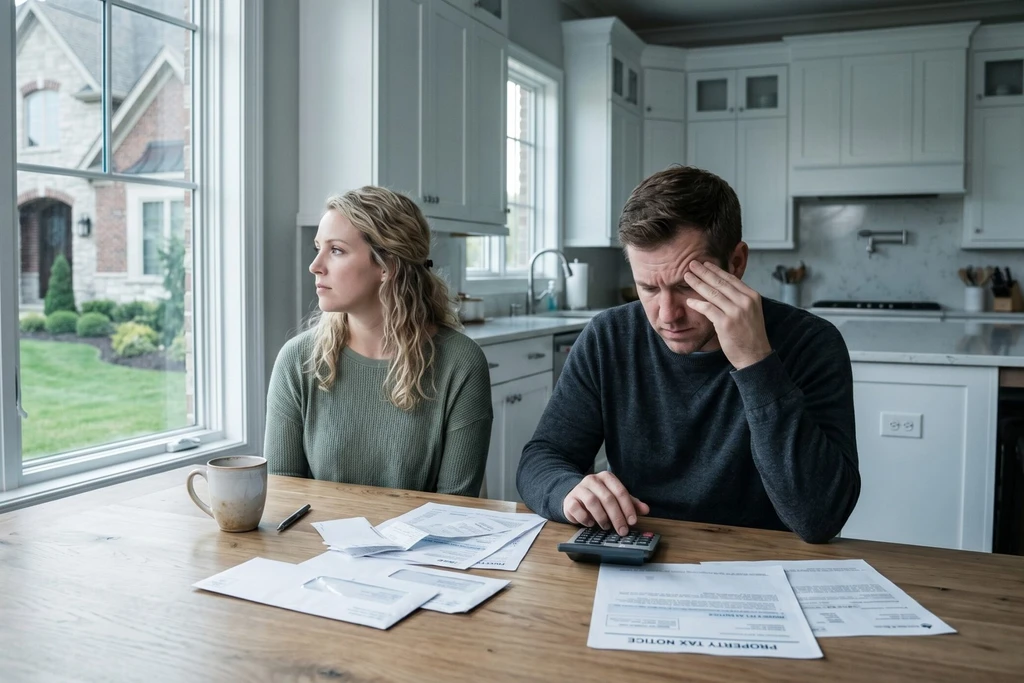
The day you close on the house, you feel rich. Six months later, you're staring at the mortgage statement, the homeowners insurance bill, the property tax assessment, and the broken HVAC quote, and you realize something painful: You don't actually own this house. It owns you.
Welcome to the financial trap that's quietly bankrupting thousands of American homeowners. The Federal Reserve Bank of Atlanta shows that as of July 2025, owning a median-priced home consumed 47% of median household income. Roughly 21 million Americans now spend more than 30% of their income on housing.
Here are seven brutal truths about buying more house than you can comfortably afford.
1. The 30% rule is already broken. A typical home already eats 47% of a typical household's income. Spending above 30% means you've voluntarily entered unaffordable territory.
2. Your fixed-rate mortgage isn't actually fixed. Property taxes and insurance keep climbing. Insurance costs alone rose roughly 12% in 2025. Median monthly owner costs jumped 3.8% in a single year.
3. You can't afford to maintain the house you bought. Budget at least 1% of your home's value every year for maintenance. A $500,000 house costs $5,000 a year, just to keep it functional. Bankrate found the typical single-family home costs more than $21,000 a year to own and maintain.
4. PMI, HOA fees, and extras add hundreds a month. PMI on a $300,000 loan can run $900 to $4,500 a year. HOA fees average $291 a month. Combined with property tax creep and insurance hikes, you could be paying $750 a month above your mortgage.
5. Every dollar in the mortgage is a dollar not invested. Spending $4,000 a month on housing instead of $3,000 means giving up $1,000 a month that could go into retirement. Over 30 years at a 7% return, that grows to roughly $1.2 million.
6. You may not be able to sell when you need to. Selling costs 8% to 10% of the sale price. Plus, millions of homeowners with sub-4% mortgage rates are trapped, unable to move without trading for a 6.5% rate.
7. Foreclosure risk is rising. Foreclosures hit their highest level in six years in early 2025, driven by rising insurance, climbing taxes, and homeowners stretched too thin.
The fix? Buy less house than the bank says you qualify for. A house should serve your life, not the other way around.