Six Polymarket traders collectively earned approximately $1 million by accurately predicting a United States strike on Iran before the end of February. This significant profit, concentrated in newly created wallets active only in February, has triggered concerns about potential insider trading.
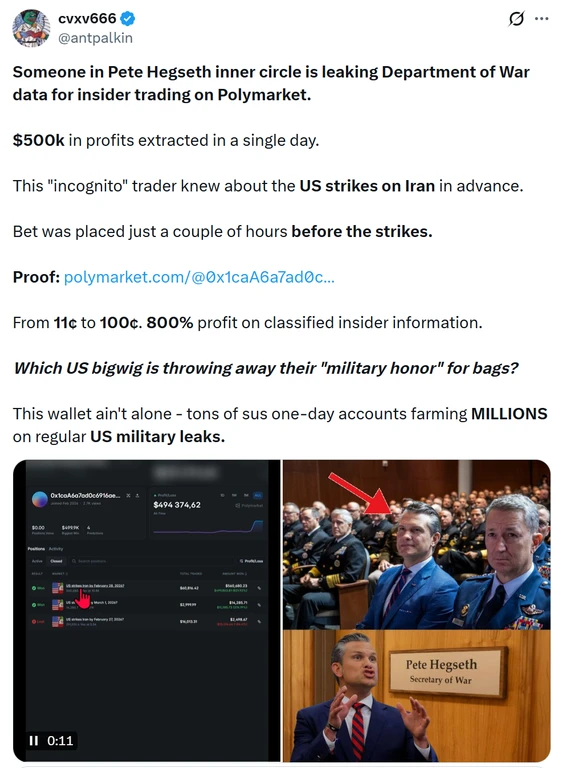
Data shows these traders placed nearly all their activity on contracts predicting the timing of a potential U.S. attack. Some contracts were purchased mere hours before explosions were reported in Tehran, with initial investments of around $0.10 yielding substantial returns. Onchain investigators noted this pattern mirrors behavior previously linked to insider activity on prediction markets.
During the recent escalation, over $529 million flowed into strike-related contracts on Polymarket. The specific February 28th contract alone saw $90 million in trading volume. While one flagged account had previously lost money, its later large wager suggests trades do not automatically prove wrongdoing. Public warnings from Washington also drew speculators.
This incident follows similar allegations on Polymarket, including traders profiting over $1.2 million on an onchain investigation contract and another earning $400,000 on a bet regarding the capture of Venezuelan President Nicolás Maduro.
In response to growing concerns, U.S. Representative Ritchie Torres is preparing legislation, the Public Integrity in Financial Prediction Markets Act of 2026, to curb insider trading on these platforms. The proposal aims to prevent officials with nonpublic information from trading contracts tied to government policy.
Meanwhile, Polymarket faces regulatory challenges worldwide, with multiple countries classifying its event-based contracts as unlicensed gambling and blocking or banning the platform.