You can’t turn on the news or open a newspaper without hearing about artificial intelligence. If you’re retired or getting close to it, it’s tempting to roll your eyes and assume this is just another tech fad for younger generations to obsess over.
Don’t make that mistake. AI isn’t just about kids generating funny pictures or students cheating on their term papers. It’s a shift in how the world operates, and it’s going to hit seniors directly.
Some of these changes are fantastic and could genuinely improve your quality of life. Others are terrifying, particularly when it comes to your financial security.
Here’s exactly how artificial intelligence is going to change things for older Americans over the next few years.
- Catching health issues before you feel them
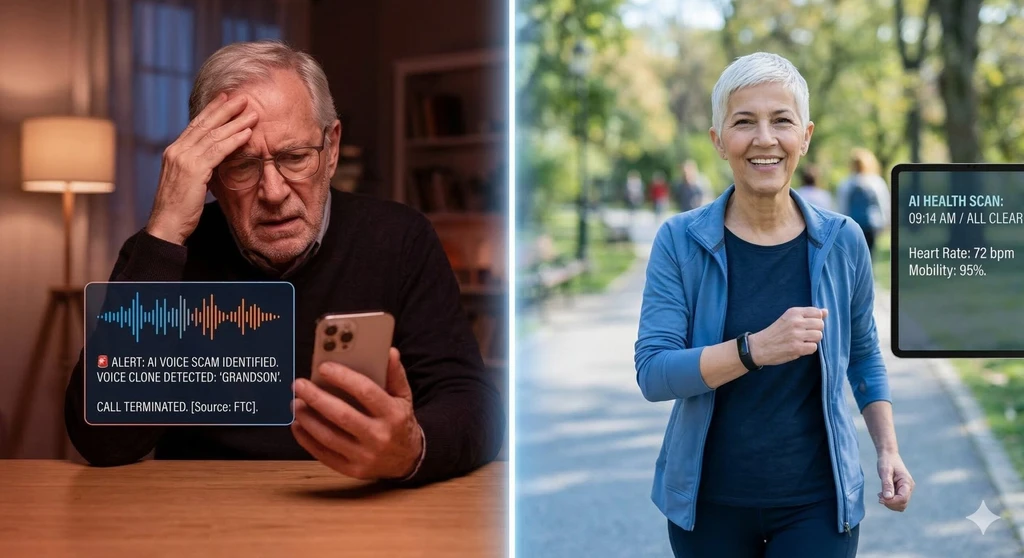
Medicine is arguably the area where AI shines brightest right now. We aren’t talking about robot doctors replacing your primary care physician. Instead, AI acts like a super-powered assistant that can spot patterns a human eye might miss.
According to the Mayo Clinic, researchers are already using AI to analyze routine EKGs and identify hidden signs of heart disease long before the patient feels a single symptom. It’s also being deployed to read mammograms and MRIs with incredible accuracy, meaning you could get diagnosed and treated much faster.
- Supercharging financial scams
This is the dark side of the technology. Scammers have always targeted older adults, but AI gives them terrifying new tools.
You’ve likely heard of the grandparent scam, where someone calls pretending to be your grandchild in jail and needing bail money. In the past, you could usually tell it was a fake by the voice. Now, according to the Federal Trade Commission, criminals only need a tiny audio clip from a social media video to clone someone’s voice entirely.
They can make it sound exactly like your grandson begging for help. You have to be more skeptical than ever before when answering the phone.
- Helping you live at home longer
Most of us want to age in our own homes rather than move to an assisted living facility. AI is making that much more realistic, but you must plan for long-term care costs that aren’t going away.
Smart home technology is moving beyond just turning on your living room lights. New AI-driven sensors can learn your daily routines.
If you usually wake up at 7 a.m. and start the coffee maker, but there’s no movement in the house by 9 a.m., the system can automatically alert a family member or caregiver to check on you. It can also detect falls without requiring you to wear a cumbersome alert pendant around your neck.
- Less frustrating customer service
If you’ve ever spent an hour screaming “operator” into the phone while trying to fix a Medicare billing issue, relief might finally be on the way.
Companies are replacing those awful automated phone trees with AI assistants that actually understand conversational English. Instead of pushing buttons, you’ll be able to explain your problem naturally, and the system will pull up your records and resolve the issue much faster.
- Fighting off loneliness
Isolation is a health risk for older adults. While a computer program will never replace human connection, AI companion bots are starting to fill a gap for seniors who live alone. These aren’t just clunky robots; they are conversational programs that can talk about history, play trivia games, or just chat about your day.
According to data from the New York State Office for the Aging, pilot programs giving AI companions to older adults have shown real success in reducing feelings of isolation.
The bottom line is that artificial intelligence is here, and ignoring it won’t make it go away. Stay vigilant against the scams, but don’t be afraid to embrace the tools that can make your life easier and healthier.