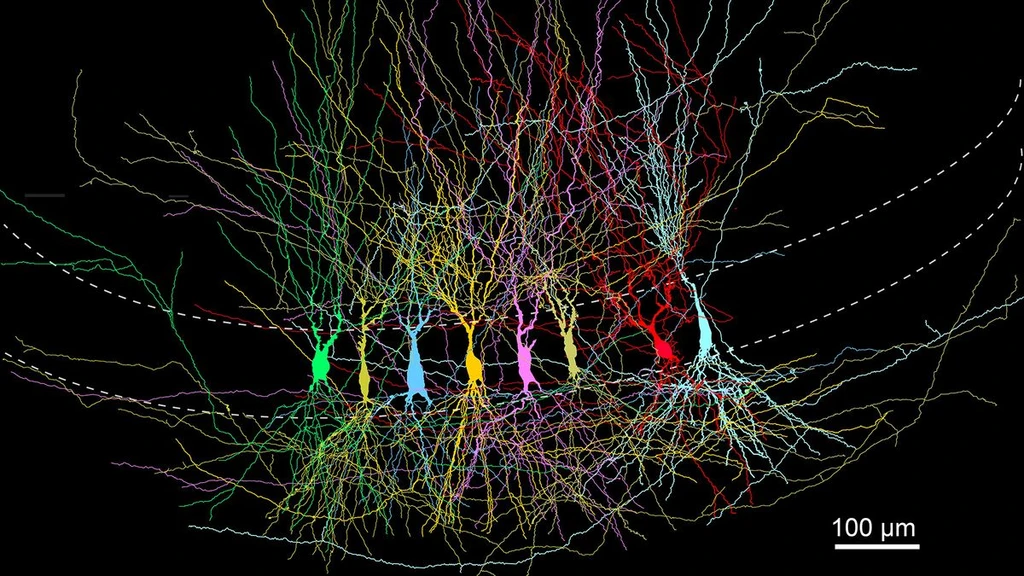
A new study in mice challenges the long-held belief that the brain's memory center starts as a blank slate. According to research published in Nature Communications, the hippocampus-specifically the CA3 region responsible for storing and recalling memories-is densely and randomly prewired at birth.
Led by neuroscientist Peter Jonas of the Institute of Science and Technology Austria, the team examined mouse brain tissue at different developmental stages. They discovered that shortly after birth, hippocampal neurons are hyperconnected in a seemingly haphazard pattern. As the brain matures, these connections are aggressively pruned, becoming sparser and more structured.
This finding refutes the idea of "tabula rasa"-that the brain begins as a clean slate. Instead, researchers describe it as a "tabula plena," or full slate, that refines itself through experience.
Jonas noted the team was surprised by both the early pruning and the strength of early connections. In young brains, a single input could trigger a neuron to fire, while mature networks require multiple inputs. This early excitability, however, leads to imprecision: overlapping neural activity makes it difficult for the brain to distinguish one memory from another, which may explain why we remember so little from infancy.
As the brain matures, neural selectivity increases, leading to more distinct memory networks. The research aligns with developmental psychology showing that memory becomes more specific with age. The prewired brain may give a crucial head start, ensuring necessary wiring is in place for early communication between neurons.