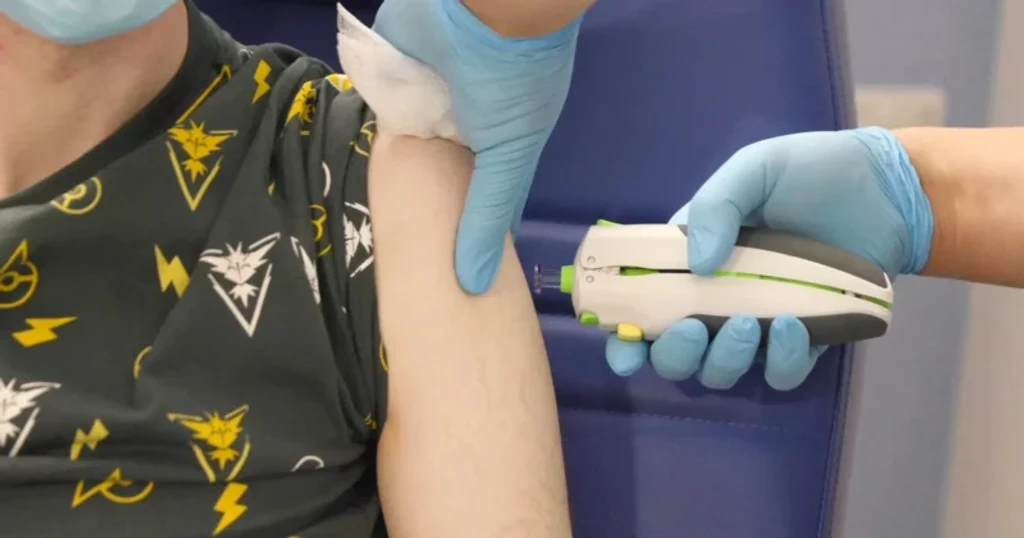
For the first time, a vaccine component designed entirely by artificial intelligence has been tested in humans. And it worked.
Researchers at the University of Cambridge, alongside biotech firm DIOSynVax, announced on June 5 that their AI-engineered vaccine candidate completed a Phase I clinical trial with no significant side effects. The trial involved 39 healthy volunteers conducted at Addenbrooke’s Hospital and the University of Southampton.
The vaccine is designed to protect against the entire Sarbeco group of coronaviruses, including SARS-CoV-2, the original SARS virus, and bat coronaviruses.
The research team fed genetic sequence data from a broad range of coronaviruses into AI systems. The AI identified the viral features that remain consistent across multiple strains. From these, the AI synthesized a “super-antigen”-a single engineered protein training the immune system to recognize structural elements that coronaviruses cannot mutate away.
Professor Jonathan Heeney, the lead researcher, described the approach as a shift toward a “future-proof” model. Results published in the Journal of Infection showed the vaccine triggered promising immune responses against multiple target viruses.
Phase I trials answered the key safety question: the vaccine passed cleanly. Observers noted immune responses targeting multiple coronaviruses. Phase II and Phase III trials will prove efficacy at scale. Researchers suggest this AI methodology could apply to influenza and Ebola.