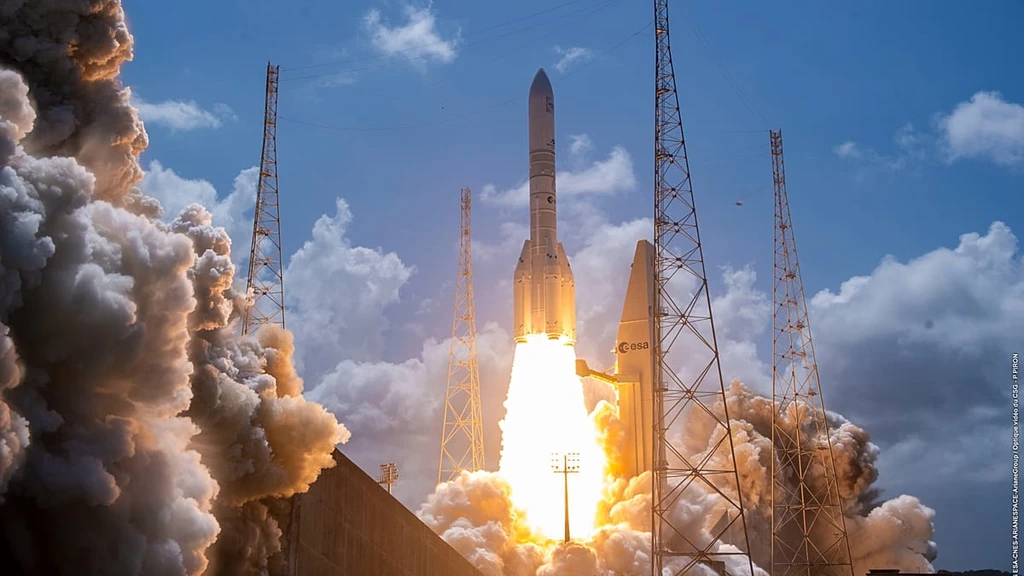
Europe has entered the era of mega-constellations with the successful maiden launch of Ariane 64, its most powerful rocket. The ArianeGroup-developed vehicle carried nearly 20 tonnes, the heaviest payload ever launched by Europe, to deploy 32 Amazon LEO satellites.
This historic launch marks Europe's return to autonomous space access after a year-long dependency on foreign providers. The Ariane 6 program, developed since 2014, features two versions: Ariane 62 with two boosters and Ariane 64 with four. The Ariane 64's capability is crucial for missions like deploying large satellite constellations.
Arianespace secured its largest private contract with Amazon, totaling 18 launches, to support Amazon's plan for over 3,000 satellites aimed at providing fast internet to underserved areas. This initiative places Amazon Leo in direct competition with Elon Musk's Starlink.
Philippe Clar, Director of Space Transport Programmes at ArianeGroup, highlighted the collaborative effort: "In Europe, 13,000 people from 13 countries have been working on this launch vehicle. 600 European companies have supplied the various components of the rocket." The successful flight of Ariane 64 demonstrates Europe's capacity for complex missions and bolsters its space sovereignty.
David Cavaillolès, CEO of Arianespace, stated, "This is a major step forward for us. Arianespace was founded 45 years ago, and the vision of my predecessors was to take an institutional launch vehicle, Ariane 1, and bring it to the commercial market."
Following the decommissioning of Ariane 5 in 2023, the delays in Ariane 6 development left Europe without independent launch capabilities. The successful launches of Ariane 62 and now Ariane 64 signify a pivotal moment for European space ambitions.