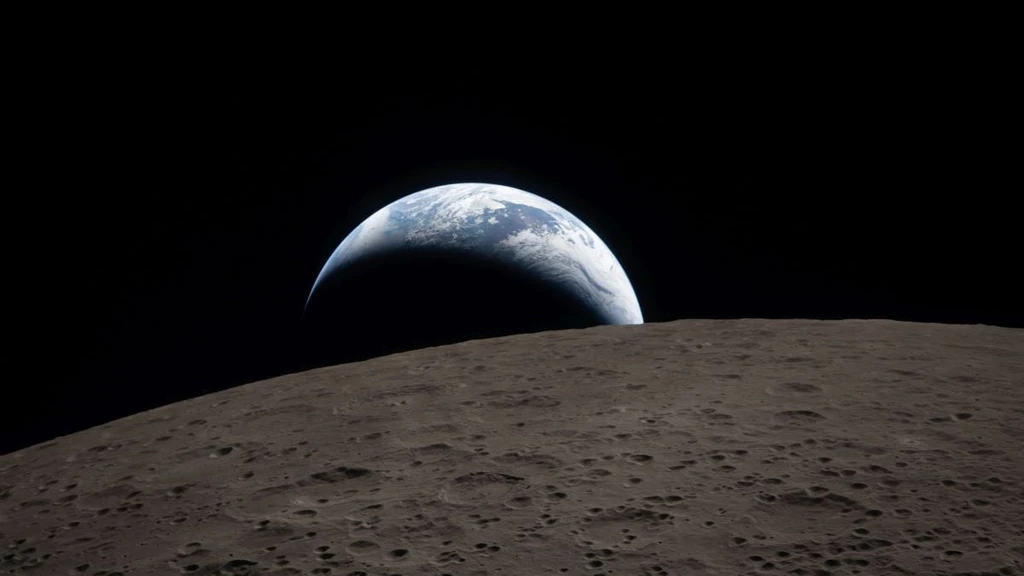
The Artemis II crew has sent back spectacular photos from the far side of the Moon, marking a historic achievement in human space exploration. Images include Earth rising over the lunar limb and a rare in-space solar eclipse observed as the Moon passed between the Orion spacecraft and the Sun. High-resolution pictures showcase the heavily cratered geology of the far side, starkly contrasting with the near side's volcanic plains.
The seven-hour flyby on April 6, 2026, involved a 40-minute communication blackout as the spacecraft passed behind the Moon. During this period, mission commander Reid Wiseman, pilot Victor Glover, and mission specialists Christina Koch and Jeremy Hansen captured detailed imagery. The spacecraft made its closest approach to the Moon at 6,545 kilometers (4,067 miles) from the surface.
Upon emerging from behind the Moon, the crew observed a total solar eclipse for nearly an hour, providing a unique opportunity to study the Sun's corona. They also documented faint meteoroid impacts on the lunar surface.
Scientists are analyzing the downlinked images to study the Moon's geologic evolution, documenting impact craters, ancient lava flows, and surface fractures. The data gathered will inform future Artemis missions.
The Orion spacecraft is now en route back to Earth, with splashdown targeted for April 11, 2026. This return journey is considered the most dangerous part of the mission due to high-speed atmospheric reentry.
The Artemis program continues with Artemis III, scheduled for 2027, and Artemis IV, targeted for early 2028, which aims for a crewed landing near the Moon's south pole.