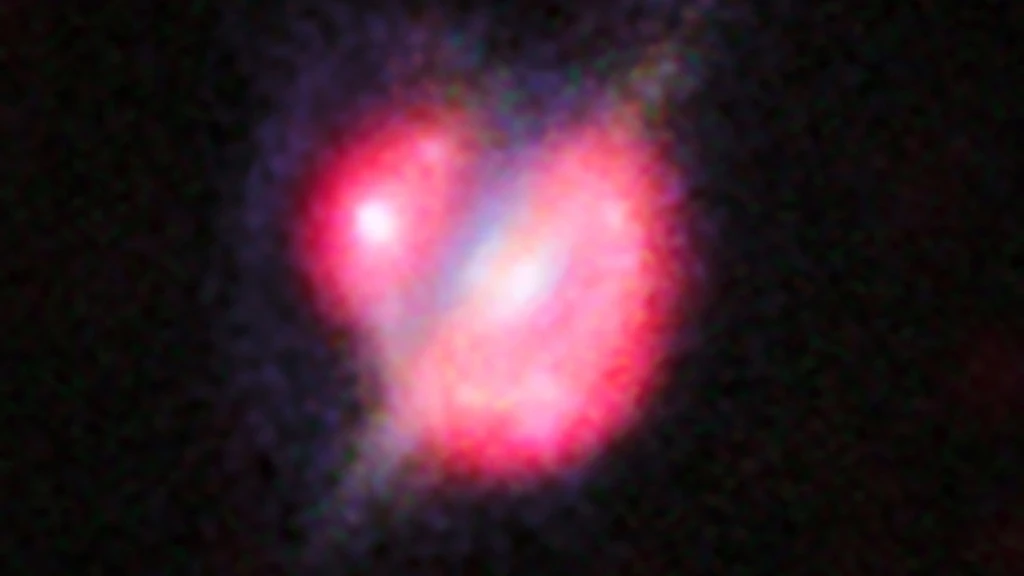
Astronomers have identified the brightest and most distant 'space laser' yet, a phenomenon known as a gigamaser, located 8 billion light-years away. This powerful emission is generated by a massive galactic collision where compressed gas stimulates hydroxyl molecules to release intense radio waves.
The record-breaking discovery was made using South Africa's MeerKAT radio telescope. The signal's journey to Earth was amplified by a foreground galaxy acting as a natural gravitational lens, magnifying the cosmic event.
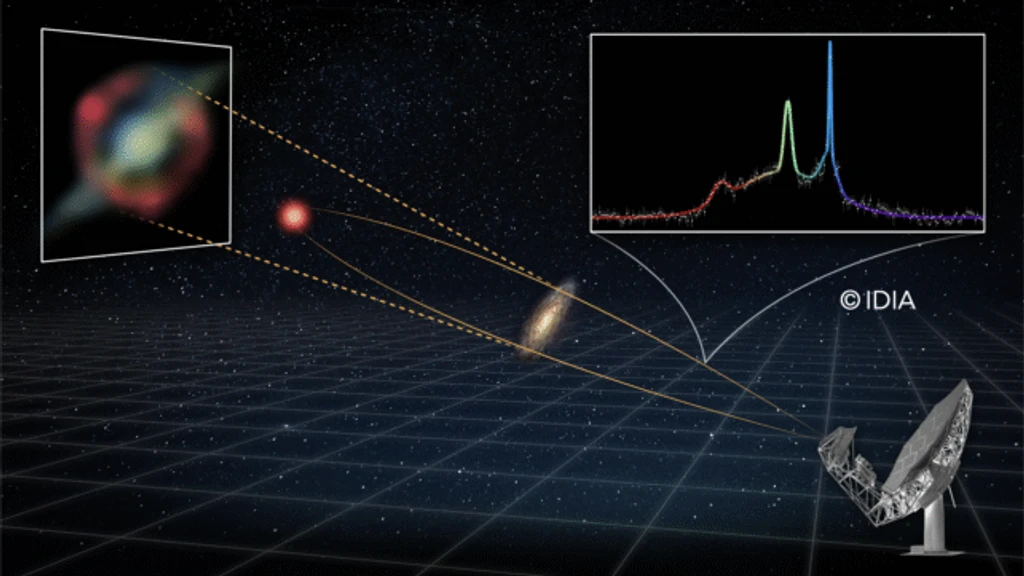
A natural astrophysical maser, the precursor to a laser, involves atoms or molecules releasing photons at the same energy level. Megamasers and gigamasers are more powerful versions produced by energetic events like supermassive black holes or colliding galaxies.
This newly discovered gigamaser, HATLAS J142935.3-002836, is billions of times brighter than a typical maser. Its extreme energy output is fueled by the merger of two galaxies, which compresses gas and triggers intense star formation. The resulting stellar newborns stimulate hydroxyl molecules, amplifying microwave emissions.
The light from this event has traveled 7.82 billion light-years, surpassing the previous distance record. Its exceptional brightness is attributed to both the gigamaser's power and the magnification effect of the gravitational lens.