
Ethereum co-founder Vitalik Buterin suggests artificial intelligence can create more efficient decentralized governance models, empowering users to make better-informed decisions.
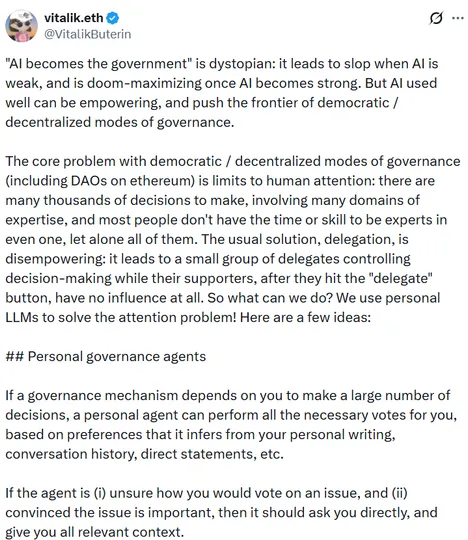
Buterin highlighted that a core challenge in democratic and decentralized governance, such as DAOs, is the "limits to human attention." The sheer volume of decisions requiring diverse expertise or significant time is often overwhelming for individuals.
He stated that the common solution, delegation, often leads to disempowerment, concentrating control in a small group of delegates without genuine influence for their supporters.
Average participation rates in DAOs are estimated between 15% and 25%, contributing to power centralization and ineffective decision-making. This can escalate to "governance attacks," where malicious actors exploit token holdings to pass harmful proposals unnoticed.
Buterin proposes personal assistant large language models (LLMs) could resolve the "attention problem" by furnishing users with essential voting information. These agents could infer user preferences from personal communications and execute votes accordingly.
If an agent is uncertain about a crucial vote, it should directly engage the user, providing necessary context.
Addressing privacy concerns, Buterin noted that sensitive information is often required for critical decisions. He proposed a solution where users' personal LLMs process private data in a secure "black box," outputting only the judgment without revealing the sensitive information or the LLM's contents.