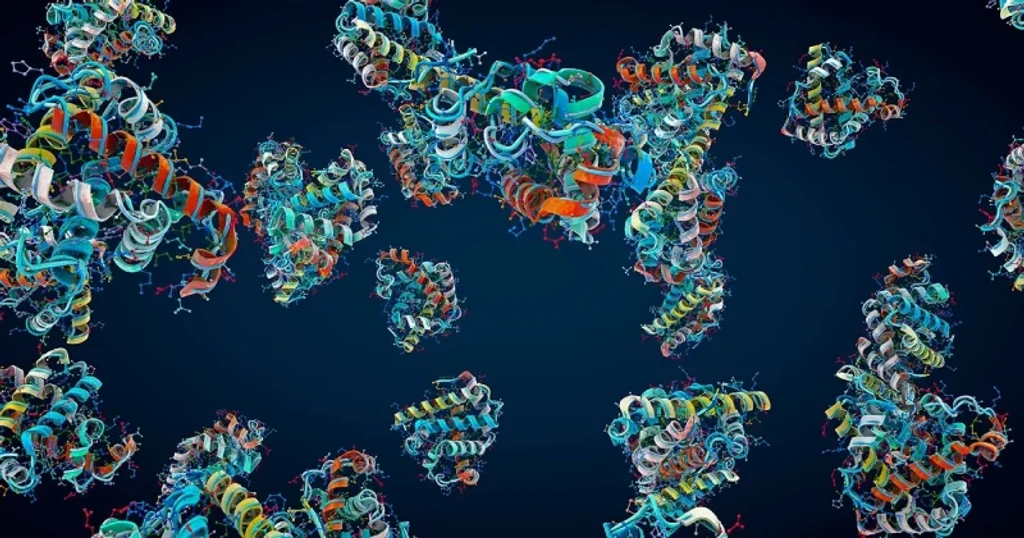
Biohub, the nonprofit research organization co-founded by Mark Zuckerberg and Priscilla Chan, has released what it calls the most ambitious open-source toolkit in protein science: a suite of three AI models designed to map, predict, and design proteins at an unprecedented scale.
The centerpiece is the ESM Atlas, covering 6.8 billion proteins. To put that in perspective, the human body contains roughly 20,000 protein-coding genes. The atlas charts territory orders of magnitude beyond what any individual lab could catalog.
The release includes three tools working in concert. ESMFold2 handles structure prediction and protein design. ESMC is a protein language model trained on billions of sequences, treating amino acid chains the way GPT treats words. The ESM Atlas serves as a comprehensive database spanning those 6.8 billion proteins.
Biohub reports that the models can design functional binders with therapeutic-level affinity-meaning AI-designed proteins actually stick to their targets well enough to work as potential drugs. These results have been validated through lab testing, not just computational prediction.
All three models are open-source, available to any researcher with the computational resources. This is a deliberate choice: Biohub is positioning these tools as public infrastructure, not a proprietary advantage.
This release is part of Biohub's broader Virtual Biology Initiative, announced in April 2026, with a total commitment of $500 million. $400 million is earmarked for internal investments, including development of models like these. The remaining $100 million funds external data-generation initiatives that produce training data for AI models.
Biohub's nonprofit structure means it doesn't need to recoup its investment through drug sales or licensing fees. That freedom allows open-source releases without concern for shareholder reaction.
For the drug discovery market, this dramatically lowers the barrier to entry for biotech startups that couldn't previously afford to build their own foundation models. A small team with a good hypothesis and access to ESMFold2 can now compete with labs that spent years and tens of millions on proprietary alternatives.
Biohub has stated explicitly that no cryptocurrency or blockchain technologies are involved in this research.